





Amazon earnings are back in focus — and right now, ahead of the Q1 2026 release on April 29, there is a lot more going on than just the usual AWS growth chatter. This Amazon Q1 earnings preview is drawing attention from all sides, partly because the results drop on the same day as the FOMC meeting, and partly because the AMZN stock forecast from Wall Street has been running unusually hot. Analysts have been putting out price targets anywhere from $275 to $325, and implied volatility already points to a move of more than 8% in either direction. The Amazon earnings date in 2026 also lines up with results from Microsoft, Meta, and Alphabet — making it, at the time of writing, one of the most consequential single days of this entire earnings season.
Also Read: Ray Dalio Loads Nvidia While Stock Price Target Points to $380
Amazon Earnings Date 2026, AMZN Forecast and Insider Activity

What the Numbers Look Like Heading In
Right now, consensus for Amazon earnings points to Q1 2026 revenue of around $177–188 billion — roughly a 14% increase year-over-year. Advertising revenue is also growing fast, with analysts penciling in a 21% jump to $16.84 billion. EPS sits at around $1.63, up from $1.59 in Q1 2025. These numbers are largely already baked into the stock, so the real question going into the print is whether AWS can deliver anything above expectations.
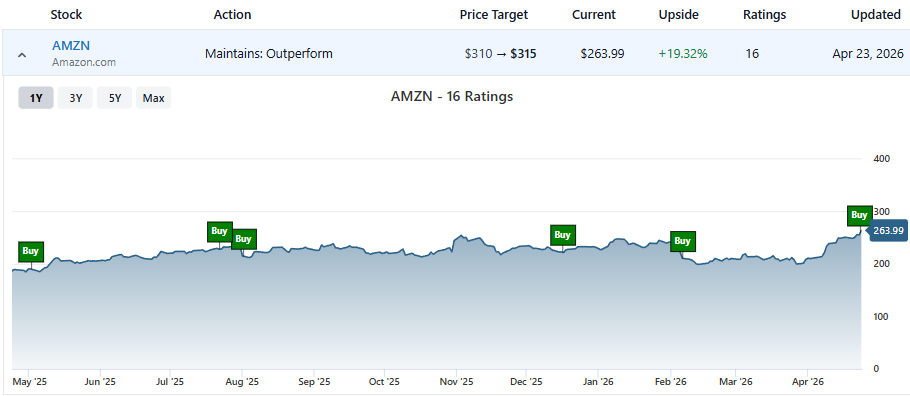
Morgan Stanley maintained its “Overweight” rating ahead of the Amazon Q1 earnings preview, noting that AWS is entering an acceleration phase for AI workload migrations and that cloud revenue for 2026 will likely come in above consensus. Among the 34 analysts who have issued price targets in the last six months, the median lands at $300. Brian Pitz from BMO Capital set a target of $315, and Justin Patterson from Keybanc went to $325 — both in the week directly before the Amazon earnings date.
The $200 Billion Question
Amazon plans to spend up to $200 billion in CapEx for 2026 — the vast majority going toward AI infrastructure — and year-over-year growth for Q1 alone runs at around 71%. That kind of spending has rattled investors before, and how management explains the return timeline during the earnings call will matter a lot. CEO Andy Jassy already pushed back on those concerns publicly ahead of the report.
Also worth flagging: Amazon secured a commitment from Anthropic to spend more than $100 billion over 10 years on Amazon Cloud technology. That gives AWS a locked-in AI customer pipeline heading into the print — and it follows a total investment commitment of around $25 billion from Amazon into Anthropic, with $5 billion added as recently as April 20. AWS AI revenue has already hit an annualized run rate of $15 billion, and the custom chip business runs at a $20 billion pace.
The Insider Trading Signal Most People Are Skipping Over
Here is the part of the Amazon earnings story that has gone largely unnoticed. Over the past six months, Amazon insiders executed 64 trades in AMZN stock on the open market. Zero of those were purchases. Every single one was a sale — and that Amazon insider trading pattern runs across the entire leadership team.
CEO Andy Jassy sold 70,744 shares for an estimated $16.29 million. Doug Herrington, who runs Worldwide Amazon Stores, sold 73,738 shares for roughly $17.32 million. AWS CEO Matthew Garman sold 35,519 shares for an estimated $7.5 million. Senior VP David Zapolsky sold 38,419 shares for approximately $8.2 million. Not one of them made a single purchase during the same period.
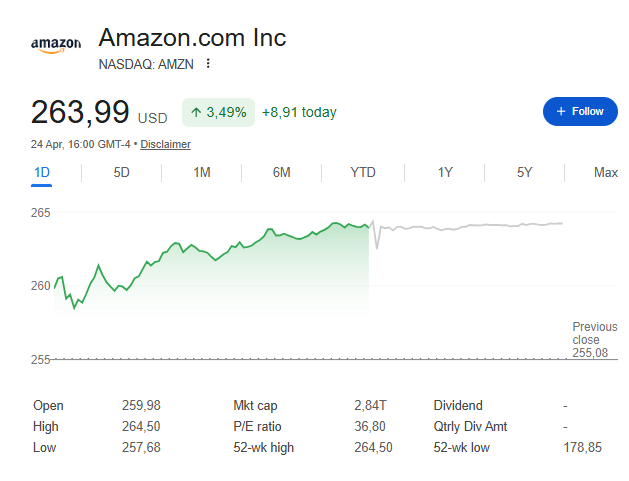
Now, Amazon insider trading at this scale does not automatically read as bearish — executives regularly sell through pre-scheduled 10b5-1 plans. But the consistency of it creates a real divergence between the market’s optimism and what the people with the most direct knowledge of the business are doing with their own money. It could mean caution ahead of earnings, or it could simply mean that the current valuation — a PE of 36.82 times, at the 49th percentile of its five-year range — already looks full to the insiders themselves.
Congressional trading adds another angle to watch ahead of the Amazon earnings date 2026. Representative Nancy Pelosi bought up to $1 million in AMZN in January 2026 and also sold up to $5 million in December 2024. Senator Markwayne Mullin purchased up to $250,000 in late December. Representative Gilbert Ray Cisneros traded AMZN nine times in the last six months — five purchases and four sales.
Put/call Ratio on Amazon Options
The put/call ratio on Amazon options currently sits at 0.62 — a low reading that signals strong bullish positioning going into the report. Implied volatility runs at 42.83%, and historically, AMZN moves an average of 6.47% on the first day after earnings. Some technical analysts also flag an overbought RSI and gap-fill risk as things to watch. On the institutional side, UBS Asset Management cut its AMZN position by 74.8% in Q4 2025, while J. Stern and Co. added 87.5 million shares in the same quarter.
Also Read: Google Stock Price Prediction For April 30, 2026
Eighteen Wall Street firms have put out buy or outperform ratings on AMZN in recent months, and none have issued a sell. Going into the Amazon earnings report on April 29, the AMZN stock forecast from Wall Street stays firmly bullish. The Amazon insider trading data and mixed technical signals are the quieter part of the picture — and the ones worth keeping an eye on as the print approaches.