






Amazon stock could hit $1,000 by 2036, according to CoinCodex’s algorithmic forecasting model, with shares trading near $249.67 right now. That kind of Amazon stock prediction sits nowhere close to where Wall Street’s own numbers point.Any Amazon stock price prediction from Wall Street falls far short of that too: the 42 analysts covering the stock average just $332.45 over 12 months, nowhere near four figures. That gap is exactly why hitting $1,000 is a decade-long story about AWS growth, not something a single earnings cycle can pull off.
Also Read: Amazon vs SpaceX: Which Stock Has More Upside After 2026?
Amazon Stock $1,000 Forecast: AMZN Price And 2036 Stock Outlook

Where AMZN Stands Right Now
At $249.67, Amazon carries a market value of right around $2.69 trillion, still about 12.1% below its 3 August record of $284.02. These numbers matter for any Amazon stock price prediction, including talk of Amazon stock $1,000 down the road: AWS revenue hit $42.2 billion in Q2, up 37% year on year, and net sales climbed 20% to $200.6 billion, while free cash flow swung from an $18.2 billion inflow to a $7.6 billion outflow as Amazon now guides 2026 cash capex to about $220 billion.
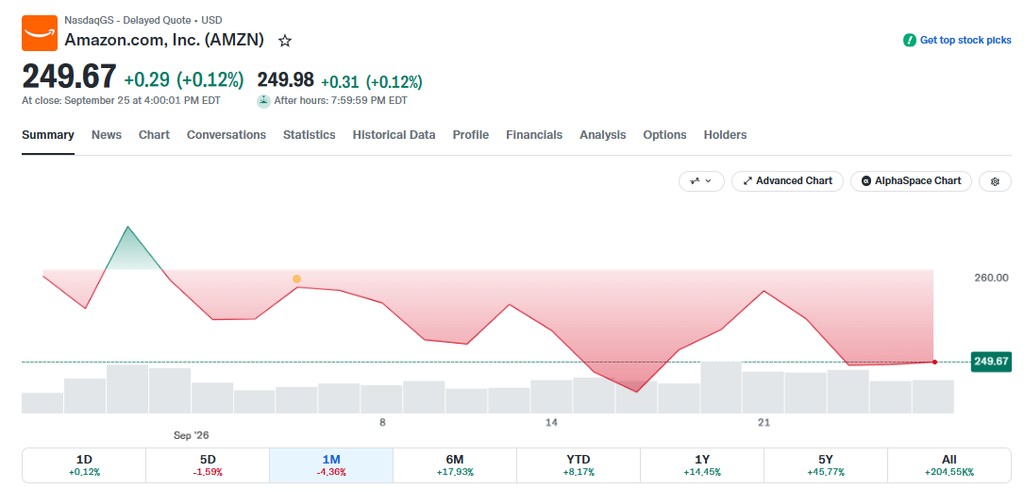
That capex line is the one every AMZN stock forecast keeps coming back to, and Andy Jassy, President and CEO at Amazon, addressed it directly on the Q2 call, saying:
“We now believe we will spend approximately $220 billion in cash CapEx in 2026. The higher cost of memory pushing this number up from our prior estimate of about $200 billion. Even at that amount, we will still not have enough capacity to meet all the demand we have in 2026, and I believe this dynamic will also be true in 2027, too.”
Also Read: Coca-Cola Dividend on October 1: How Much 100 KO Shares Can Earn You
The Long Road To An Amazon Stock $1,000 Prediction
Turning $249.67 into an actual Amazon stock $1,000 is roughly a four-times move, which is why an Amazon stock forecast 2036 spreads it across a decade instead of squeezing it into a single AMZN stock forecast. AWS would need to keep its growth rate, the roughly $496 billion backlog would need to keep converting into real revenue, and Amazon’s $190.4 billion stake in Anthropic would need to turn into durable earnings rather than stay a paper gain.
Brian Olsavsky Senior Vice President and CFO at Amazon, pointed to margin strength on that same call as proof the spending is paying off, and he put it this way:
“You’re seeing, despite the large investments, AWS margins have continued to remain strong, and we’re up 650 basis points year-over-year. 520 basis points if you exclude the derivative accounting gain.”
What Could Actually Break The 2036 Timeline
Consensus targets for 2030 cluster somewhere between $430 and $650, which shows how much compounding an Amazon stock $1,000 prediction still has to pull off in the back half of the decade. Amazon’s long-term debt has nearly doubled, to $128.9 billion in six months, to fund the building. Nobody has confirmed Anthropic’s reported October Nasdaq listing yet either, and that’s a real wildcard: it could push any Amazon stock $1,000 timeline out further and force a rewrite of every stock price prediction resting on it. Over the weekend of 12 and 13 September, the chief executives of Anthropic, OpenAI and xAI publicly backed slowing frontier-model development, a stance that, if it sticks, would slow the exact AI spending an Amazon stock forecast 2036 depends on.
None of that changes the near-term math much. The Street’s floor target, $250, actually sits just above where AMZN trades right now, and the average target across those 42 analysts implies something like 33% upside within a year, not 300%. Every AMZN stock forecast aiming for $1,000 stays a multi-decade story that leans on AWS growth, AI monetization and roughly 12% to 15% annual compounding.