





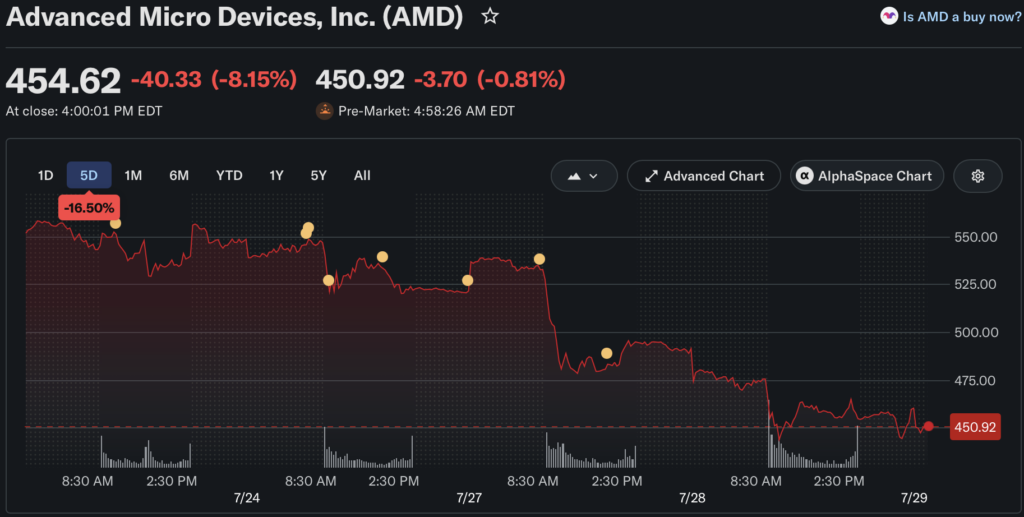
Advanced Micro Devices, Inc. (AMD) stock prices are plummeting amid an industry-wide sell off. AMD stock price has crashed to the $450 mark in the pre-market hours. The stock closed 8.15% (40.33 points) lower on Tuesday, July 28, 2026, and fell another 0.81% (3.70 points) in the pre-market hours. Let’s discuss if AMD will fall below $400, and if you should sell or buy the dip.
Will AMD Stock Price Crash Below $400?

AMD has seen massive gains over the last year. The company has been riding the ongoing AI wave, delivering stellar returns to investors. The last price crash comes after global sell offs in the semiconductor sector. Investors are uncertain about rising AI-related spending and the emergence of competition from China.
Also Read: Apple (AAPL) Market Cap Hits Record $5 Trillion, Passing Nvidia
While AMD’s latest price crash is concerning, Wall Street analysts are still quite bullish on the stock. Jefferies recently revised its stock price target for AMD to $640. Bank of America raised their target from $560 to $620. Robert W. Baird, meanwhile, doubled their estimates from $625 to $1250. Morgan Stanley, however, has a price target of $410, a 9.81% downside from current price levels.
Should You Sell Or Buy More?
AMD will release its quarterly earnings report on August 4, 2026. Analyst anticipate another record-breaking quarter for the company. AMD is expected to report record revenue and earnings per share. If the report is as bullish as many anticipate, the stock value could see a rebound in the coming days.
AMD also recently revealed its latest AI chips, claiming they could outperform Nvidia’s offerings. The new chips coupled with higher revenue could propel AMD’s stock price to new highs. Buying the dip may prove to be a lucrative decision.
Despite the bullish outlook, there are risks you should be aware of. There may be supply chain issues due to the Middle East conflict. Competition from China may also lead to supply disruptions and further sell offs.