





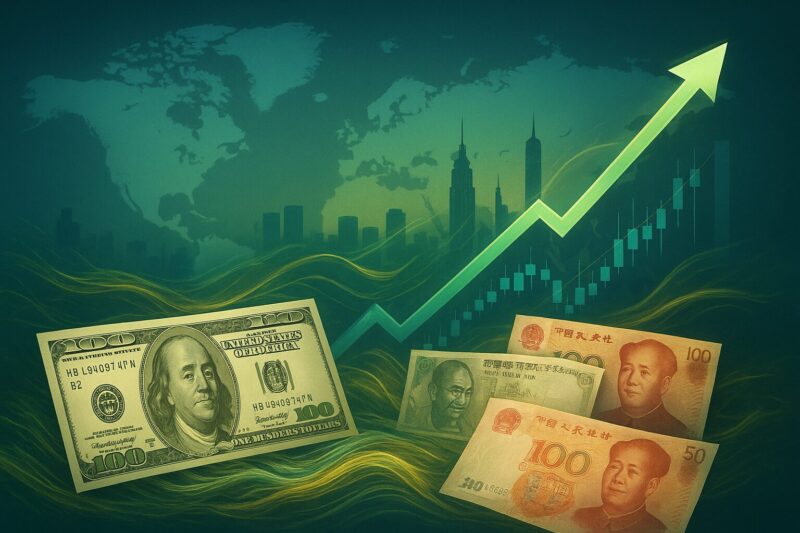
US money printing is going to restart in early 2026, and this actually comes at a pretty critical moment as BRICS nations are accelerating their efforts to reduce dollar dependence in global trade right now. The Federal Reserve officially ended quantitative tightening on December 1st, 2025, which signals a shift back toward balance sheet expansion after three years of removing liquidity from the financial system. At the time of writing, the timing couldn’t be more significant for global markets.
Also Read: BRICS Gold 2020-2025 Purchases Reach 870t, Pressuring US Dollar
US money printing Triggers Market Volatility Amid BRICS Dollar Decline
Federal Reserve Prepares Balance Sheet Expansion
The mechanics behind this shift have actually been building for months now, and markets across the board feel the implications. New York Fed President John Williams revealed in November that US money printing would need to resume, and he explained the technical reasoning behind the decision:
It will then be time to begin the process of gradual purchases of assets that will maintain an ample level of reserves as the Fed’s other liabilities grow and underlying demand for reserves increases over time.
Williams also noted that determining when reserves reach “ample” levels presents an “inexact science,” though some analysts predict the Fed could restart expansion of its balance sheet in the first quarter of 2026. The Federal Reserve has shrunk its balance sheet from around $9 trillion down to approximately $6.6 trillion over the past three years through quantitative tightening, and this process has removed money from the system to help tame inflation.
However, reserves have now fallen to levels where they compromise the financial system’s operational requirements. The banking system operates on what we can describe as financial plumbing—a network of reserves, repo markets, collateral, treasury bills, and also short-term financing mechanisms. When reserves fall too low, repo rates spike up and money markets break, just as this happened during the 2019 repo crisis and again in 2020.
BRICS De-Dollarization Accelerates Through Gold Purchases
While US money printing dominates Federal Reserve discussions right now, BRICS nations have been working to reduce their reliance on the dollar through strategic moves. Central banks purchased 166 tonnes of gold in Q2 2025, marking a 41% increase above historical quarterly averages, with BRICS nations actually leading this strategic shift away from dollar-denominated assets.
Russia’s central bank holds around 2,335 metric tons, which is closely followed by China with 2,279 metric tons. Together, these two countries control approximately 74% of BRICS’ total gold reserves, and this represents their commitment to reducing dollar exposure amid the latest US money printing news coming from the Federal Reserve. India also holds 879.98 tons, while Brazil and South Africa have smaller amounts but are increasing their stockpiles.
The BRICS de-dollarization strategy focuses on promoting local currency usage in trade along with building alternative financial institutions like the New Development Bank. This movement has been driven by desires for greater economic autonomy and also protection from what some nations view as dollar “weaponization” through sanctions.
Mike Hodgson, CEO of Serabi Gold, noted the favorable market conditions that gold producers are experiencing right now:
We’re enjoying a very preferable exchange rate, which is very much in our favor. We can do everything out of cash flow, without the need to dilute shareholders.
Ray Dalio Warns of Dangerous Bubble Formation
Bridgewater Associates founder Ray Dalio has issued some pretty stark warnings about the combination of US money printing 2025, high asset valuations, and large fiscal deficits. Dalio views the Fed’s shift from balance sheet reduction to expansion as a classic late-stage debt cycle dynamic that could actually drive gold and Bitcoin dramatically higher before an inevitable collapse occurs.
In his analysis, Dalio specifically warned about the unusual timing of this monetary easing:
This time the easing will be into a bubble rather than into a bust.
He likened the current setup to late 1999 or even 2010-2011, when strong liquidity flows inflated valuations just before major corrections happened. The combination of BRICS de-dollarization efforts along with renewed US money printing 2025 creates what he describes as unprecedented inflationary pressures that could destabilize markets.
Dalio explained that when the Federal Reserve expands its balance sheet, there’s always going to be an effect on markets. The effect is going to be more liquidity in the system, lower real yields, higher valuations, and also increased risk-taking behavior across financial markets. This all creates more upward pressure on financial assets, but it’s not sustainable indefinitely.
The convergence of resumed US money printing news and accelerating BRICS US dollar decline creates conditions for what Dalio describes as a “melt-up“—a final phase of exuberance before tightening measures eventually burst the bubble. It would be reasonable to expect that, similar to late 1999 or 2010-2011, there would be a strong liquidity melt-up that will eventually become too risky and will have to be restrained.
Policy Shifts and Dollar Reserve Decline
An important factor to consider is that Jerome Powell’s term as Fed Chair expires in May 2026. President Trump will be selecting his replacement, and Trump has repeatedly criticized the Federal Reserve for keeping interest rates too high and moving too slowly on cuts. A new Fed Chair who’s aligned with Trump’s views could mean more dovish monetary policy, which would include greater tolerance for inflation and also more aggressive rate cuts—all of which would support growth and liquidity in the system.
The dollar is currently at about 58-60 percent of the world reserves and the share of dollar in the BRICS trade has declined to 59 percent compared to 85 percent in only eight years. This is growing at a faster pace, with the BRICS countries coming up with alternative forms of payment and expanding their reserves of gold.
Also Read: China Launches 2026 BRICS Strategy
The worldwide central banks have been buying more than 1,000 tonnes of gold per year over three years in a row that forms a stable price base and proves that the shift to hard reserves has become systemic. And coupled with high stock prices, fiscal deficits, printing new US money, and possibly more accommodative Federal Reserve, market observers believe that there are the conditions to become highly volatile in the future. Another difficulty to an already fragile situation is the decline in the BRICS US dollar, which is not only complicating the entire situation of the old dollar being challenged, but also the external geopolitical changes that are redefining the world financial structure currently.