





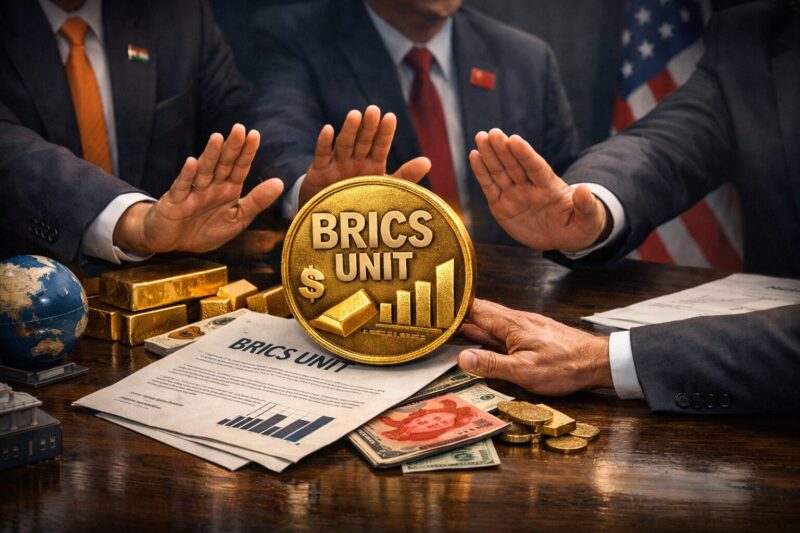
The resistance to BRICS Unit is on the rise in the present moment because India and China have declined to adopt a single settlement currency and this is creating some very ugly schisms inside the bloc as of now. According to India the External Affairs Minister, the decision to abandon the dollar is not actually in the economic policy of New Delhi. China is instead putting more effort into developing its own currency.
The resistance is posing a threat to BRICS de-dollarization driven activities. This may affect international trade settlements. Key economies are placing stability over taking the challenge of US dollar hegemony. This Unit resistance of the BRICS also begs the question of whether the bloc can continue to be unified. This is becoming clear that an alternative to the US dollar common to the BRICS is confronted with challenges internally.
Also Read: BRICS Plan to Move From 50% to 65–70% Global Gold Control in 2026
BRICS Unit Resistance Challenges US Dollar And Global Stability

India Firmly Rejects Common Currency Proposal
At the IT-BT Round Table 2025, Union Commerce Minister Piyush Goyal made India’s position on BRICS Unit resistance quite clear when he stated:
“Imagine us having a currency shared with China. We have no plans. It is impossible to think of a BRICS currency.”
This rejection of the BRICS Unit has been echoed by other Indian officials as well. Indian External Affairs Minister Jaishankar Subramanian emphasized at the Carnegie Endowment for International Peace back in October 2024:
“We have never actively targeted the dollar. That’s not part of either our economic policy or our political or strategic policy.”
India’s stance on BRICS de-dollarization has been shaped by concerns over economic stability and also existing trade relationships with Western nations. The country views the dollar as essential for maintaining financial security during times of economic turbulence. Officials have expressed worries that a BRICS US dollar alternative could potentially disrupt global trade flows.
China Pursues Independent Path for Currency
China has been marketing its currency as an option since 2008. The nation has entered into dozens of currency swap agreements with different trading partners throughout the years. The idea of BRICS Unit resistance in Beijing is in reality because of its emphasis on currency internationalization as opposed to aiding a collective tool. The Cross-Border Interbank Payment System contained 184 direct participants in 167 countries. Even more, at least 80 central banks are currently holding reserves of about 274 billion dollars at this point.
China’s approach to BRICS de-dollarization differs significantly from Russia’s push for alternatives. While Russia has been advocating for a unified approach to international trade settlements, China is believed to see more value in promoting its own currency’s global expansion independently. This divergence in strategy has contributed to the growing BRICS Unit resistance within the bloc.
Economic and Political Obstacles Block Progress
Chintamani Mahapatra, founder of the Kalinga Institute of Indo Pacific Studies, explained some of the fundamental challenges facing BRICS Unit efforts:
“Unlike the European Union, we [BRICS countries] don’t have a common market. We don’t have a common trade policy. We have nothing in common.”
Russian President Vladimir Putin acknowledged at the Valdai Discussion Club in November 2024 that:
“I have heard a lot of discussion among experts and in journalistic circles about creating a single currency, but it is too early to talk about this, and we don’t have such goals among ourselves right now.”
126-point Declaration
The July 2025 BRICS Summit at Rio has been characterized by a 126-point declaration that did not mention BRICS de-dollarization or currency programs at all. This has confirmed that BRICS Unit opposition has been a successful way of blocking activities in the bloc. Mechanisms of trade have so far been limited to bilateral transactions and local currencies. Over 95 percent of Russian and Iranian trade is being conducted in local currencies in 2024. Member countries remain focused on the need to have economic stability. They also focus on trade relations rather than difficult international trade settlements dominated by dollar.
Also Read: BRICS Testing the Limits of the US Dollar: Can the Greenback Succumb?
How challenging it has become to have major economies to agree on monetary policy when they have such varying economic interests, as well as geopolitical interests, has been made clear by the resistance to a unified BRICS Unit. Although other members such as Russia have advocated options to draw down exposure to Western sanctions, other members such as India and China have demonstrated that they will not compromise their economic relationship with the West in the name of a common BRICS US dollar alternative. This BRICS Unit opposition is bound to keep on influencing the future of the bloc with regard to its financial cooperation in the predictable future.