





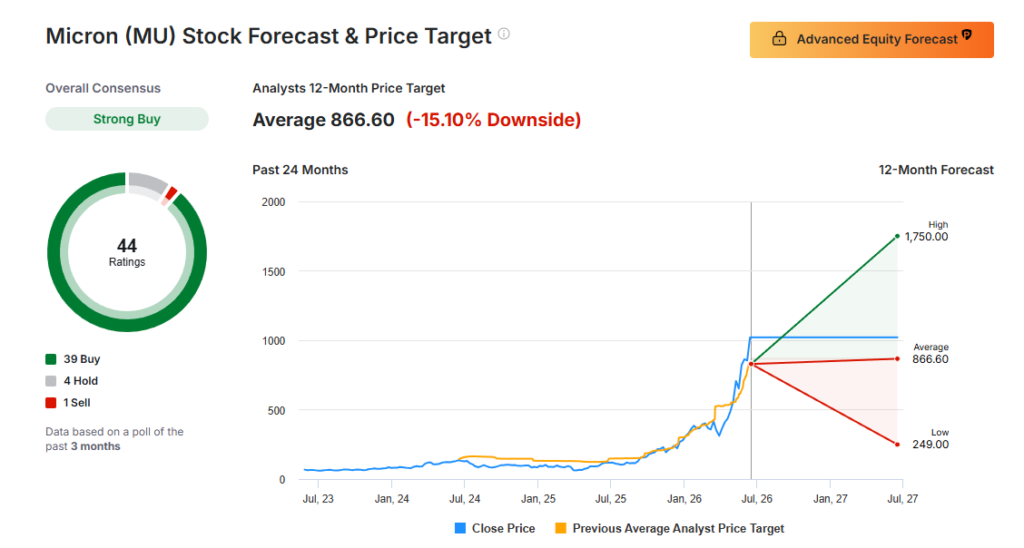
Micron stock price prediction 2030 estimates range from roughly $260 on the bearish end to above $3,000 in the most optimistic bull scenarios, and the spread alone tells you a lot about how uncertain the road ahead really is. At the time of writing, 39 out of 44 Wall Street analysts rate MU a Buy, with an average 12-month price target of $866.60, though that figure also sits about 15.10% below where the stock is currently trading. The MU stock long-term forecast is essentially a call on whether the AI memory supercycle sustains itself through the rest of the decade, or whether the semiconductor market’s old boom-and-bust pattern comes back the way it has more than once before. How much is Micron stock selling for right now matters less, really, than what the next few years of High Bandwidth Memory demand actually look like.
Also Read: Micron Stock Bullish Momentum: Should You Buy MU Ahead of Earnings?
Micron Price Target for 2030 And MU Stock Forecast Into 2026
Where The Micron Stock Price Prediction for 2030 Stands Right Now
Wall Street projections for Micron stock 2030 price prediction break into three broad camps. The bull case, driven by AI infrastructure spending, cloud buildout, and also robotics demand, is built on EPS growing somewhere in the 10 to 15% range annually through the later part of the decade. Apply a 20x to 30x earnings multiple to those numbers, and MU could reach the $2,500 to $3,200 range by 2030. A more moderate MU stock long-term forecast from institutional models puts the stock in the $600 to $1,050 band. The bear case is also worth understanding: if memory supply catches up with AI demand and the market tips into oversupply again, bearish analysts warn the stock could fall back to the $260 to $300 range. That is not a fringe scenario at all. It is grounded in patterns the memory market has repeated more than once.
The Micron stock prediction end of 2026 is also widely debated right now, with a range of $435 to $1,200 per share depending on whether HBM shortages hold and whether multi-year supply contracts continue to underpin earnings visibility.
Analyst Targets And What The CEO Has Been Saying
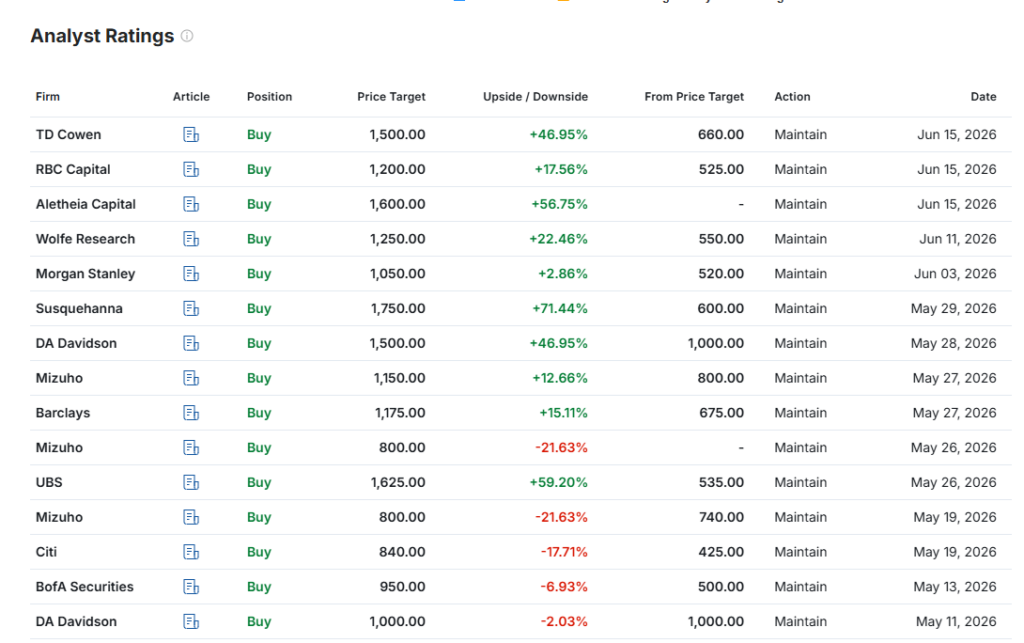
The current analyst ratings table shows targets ranging from $800 at Mizuho all the way up to $1,750 at Susquehanna, and also $1,625 from UBS and $1,600 from Aletheia Capital. All of those carry Buy ratings. TD Cowen sits at $1,500, RBC Capital at $1,200, and Morgan Stanley at $1,050, also a Buy. That kind of spread on a single stock’s 12-month Micron price target shows how much variance analysts are building into long-term models right now, where inputs like AI capital expenditure cycles, memory supply dynamics, and geopolitical trade risks are all moving at the same time.
Sanjay Mehrotra, Chairman, President and CEO of Micron Technology, had this to say in March 2026:
“Micron set new records across revenue, gross margin, EPS, and free cash flow in fiscal Q2, driven by a strong demand environment, tight industry supply, and our strong execution, and we expect significant records again in fiscal Q3. In the AI era, memory has become a strategic asset for our customers, and we are investing in our global manufacturing footprint to support their growing demand.”
That tone from the top keeps the MU stock long-term forecast anchored in bullish territory for most analysts. Mehrotra also said the following in fiscal Q1 2026:
“Micron’s technology leadership, differentiated product portfolio, and strong operational execution position us as an essential AI enabler, and we are investing to support our customers’ growing need for memory and storage.”
The Risks Behind The Micron Stock Price Prediction for 2030
Forecasting a semiconductor stock four or more years out carries a lot of structural uncertainty. Supply chains shift, new manufacturing entrants show up, and changes in AI chip architecture could cut memory demand per compute unit in ways nobody prices in today. The Micron stock prediction for the end of 2026 will likely set the tone for the longer view: a sustained HBM demand cycle keeps the 2030 bull case alive, but a memory market correction, or even a slowdown in cloud capex from the big hyperscalers, could compress valuations fast. The bear case is not theoretical.
It has happened before in the memory sector, and it is also part of why how much is Micron stock selling for at any given moment tells you very little about where the Micron stock price prediction for 2030 will actually land.