




Is Micron stock too expensive right now? At around $698 a share, with a 52-week range stretching from $90.93 to a high of $818.67, that question comes up constantly. The stock already rallied over 600% from its lows, which sounds excessive on its face. The MU stock price target math, though, tells a pretty different story: a forward price-to-earnings ratio of roughly 7x to 8x and a PEG ratio near 0.26 put Micron well below the broader S&P 500 average on a valuation basis right now. Whether Micron stock will go up further from here is a question Wall Street genuinely splits on, and the answer comes down almost entirely to how long the AI memory shortage holds.
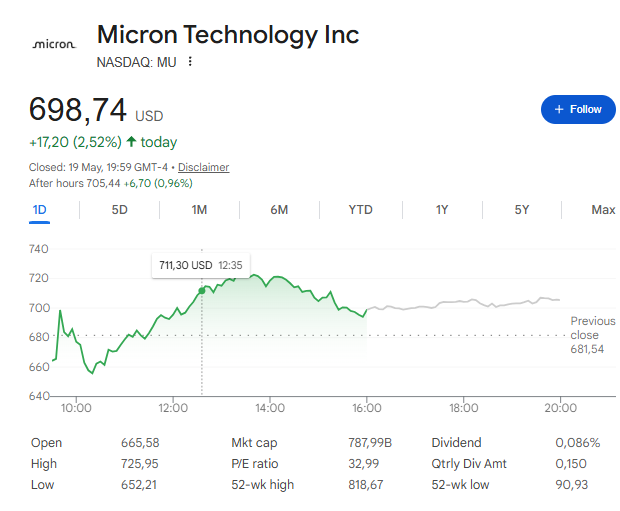
Source: Yahoo Finance
Micron Stock Forecast for 2026 and MU Price Target Analysis — Will It Go Up?
The $1,200 Case and Why the Numbers Back It Up
The bull case for Micron stock not being too expensive gained attention lately. Take the company’s trailing P/E of around 39x, multiply it by the consensus fiscal 2026 EPS forecast of $32.45, and you land at a target of $1,275. Even the more conservative EPS estimate of $30.28 on the low end still produces a price of roughly $1,190, a 183% gain from where MU was trading at the time. The company’s Q1 fiscal 2026 results, reported in late November 2025, supported that kind of optimism: revenue of $13.6 billion, up 57% year over year, DRAM accounting for 79% of the total, and a gross margin of 45.3%.
The memory shortage underpinning all of this is also real. Intel CEO Lip-Bu Tan said the crunch will not ease until 2028. And in its Q1 fiscal 2026 earnings call, Micron’s own management made the scale of the demand problem very clear:
“Despite significant efforts, we are disappointed to be unable to meet demand from our customers, across all market segments. We have completed agreements on price and volume for our entire calendar 2026 HBM supply, including Micron’s industry-leading HBM4.”
Selling out an entire calendar year of HBM supply is a pretty remarkable data point on its own, and it also explains why analysts keep lifting their MU stock price targets. At the time of writing, the three most recent upgrades came from Citigroup ($840), Melius Research ($1,100), and Mizuho ($800), all on May 19, putting the average of those three alone at over $913.
Also Read: Micron Stock Will Surge to $2,000 Within a Year, Analysts Say
Why Should You Buy MU Stock? What Analysts Say About the MU Stock Price Target
Mizuho’s Vijay Rakesh, one of the more consistently bullish voices on Micron stock, raised his MU stock price target to $800 from $740 and kept an Outperform rating. He argues pricing strength in NAND and DRAM markets will last well beyond this year.
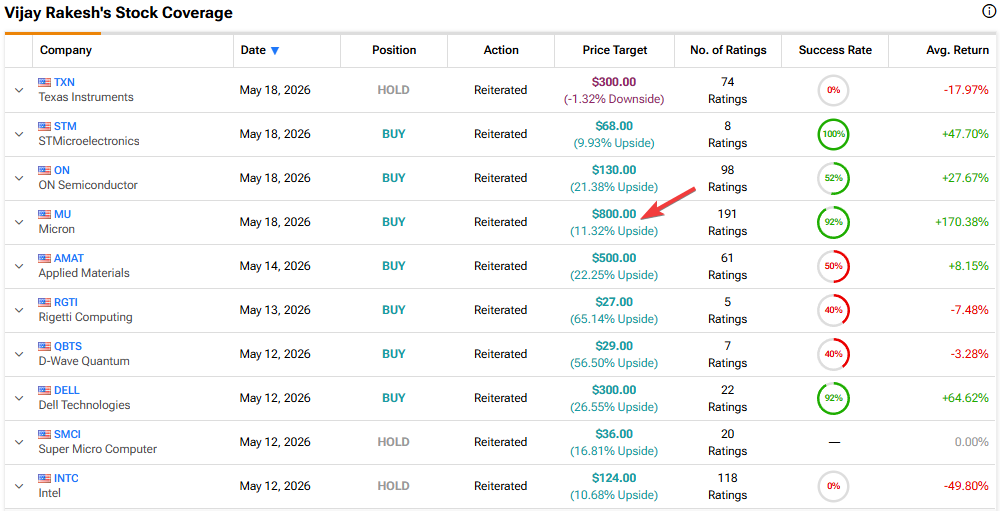
Rakesh wrote in his May 19 research note:
“We continue to note pricing tailwinds in 2026 from AI server demand as we see NAND pricing up 413% y/y and DRAM up 355% y/y. We note potential for further pricing tailwinds for Micron as a potential Samsung strike looms, while Micron also is expected to report May-quarter earnings on June 24.”
In an earlier note, Rakesh also pointed to “agentic AI driving memory demand higher,” and projected HBM revenue growing at a 40% compound annual rate to surpass $100 billion by 2028. His fiscal 2027 estimates call for revenue growth of 66% and EPS growth of 80%, year over year.
Will Micron Stock Go Up, or Is a Correction Coming First?
Not everyone shares that optimism. Seeking Alpha analyst Victor Dergunov, who bought MU shares in the $106 to $119 range in 2025, downgraded the stock to Sell on May 18, citing parabolic price action and a market cap closing in on $1 trillion.
Dergunov stated in his downgrade note:
“While Micron could go to $1,000 or $1,200 or possibly even higher if the memory shortage persists and the market remains in FOMO mode, it is highly unlikely that Micron could keep its price elevated around there. In fact, there are many stocks that appear to illustrate bubble-like behaviors, but Micron and Sandisk especially.”
Is It Too Late to Buy Micron? A Correction to The $500 to $600 Range
Dergunov’s near-term call sits at a correction to the $500 to $600 range. The broader bear case rests on a straightforward historical argument: the memory market has always normalized eventually, supply catches up to demand, pricing power fades, and margins compress. Micron also faces real competition from Samsung and SK Hynix, both of which are ramping capacity aggressively right now. The average 12-month analyst price target across the full coverage universe sits at around $600, which actually implies downside from where MU trades today.
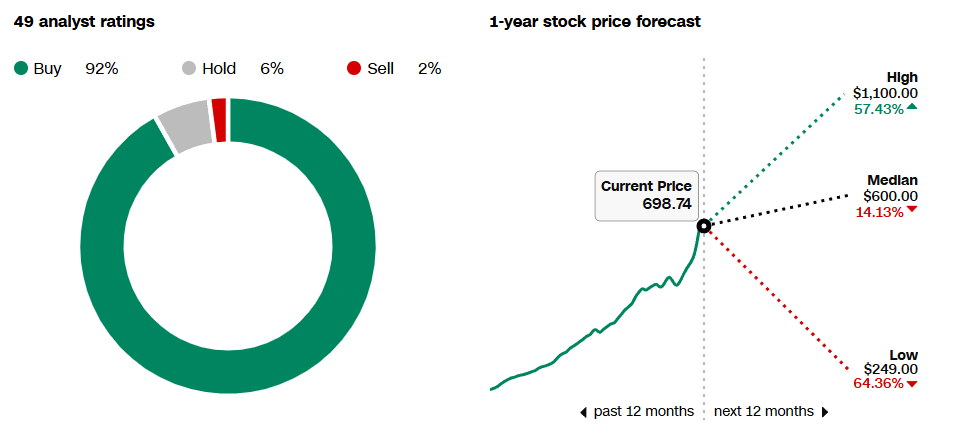
Source: CNN Business
Macro headwinds add to the pressure. The 30-year Treasury yield hit 5.198% on Tuesday, its highest since July 2007, and that kind of rate environment tends to weigh on tech stocks priced on future earnings. CEO Sanjay Mehrotra also sold 40,000 shares at $536 in early May, and insiders overall moved around 106,000 shares worth roughly $47 million over the past three months.
So is it too late to buy Micron stock? That really depends on which part of the story you find more convincing. The bull side, that Micron stock is not too expensive here, rests on a structural memory shortage with no near-term fix, a valuation that still looks cheap on a forward basis, and a position as the only major American DRAM producer in a three-player global market. The bear side says a stock trading near a $1 trillion market cap in a cyclical, commoditized industry already has a lot of good news baked in. Both arguments hold water, and that tension is exactly what makes the MU stock price target debate so hard to call heading into the second half of 2026.