





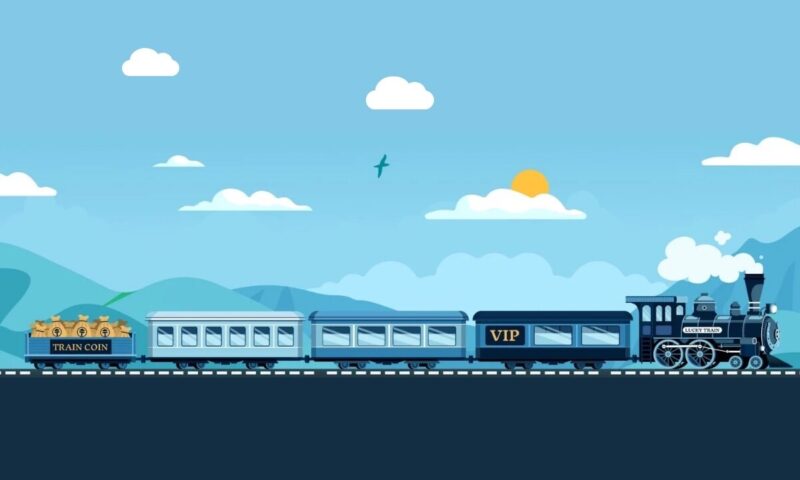
Web3 gaming has seen substantial growth over the last few years. The trend is expected to continue moving upward over the coming years. Lucky Train, a new project with a novel approach to Web3 gaming, has combined a gamified experience and a staking-like participation model. The project built its platform on the TON blockchain and has integrated a staking-like activity, which looks like a train journey. Let’s discuss how the project has brought fresh ideas to Web3 gaming.
How Does Lucky Train Work?
In Lucky Train, participation takes the form of a train ride. To start a ride, a user buys a ticket with TrainCoins, a utility token of the Lucky Train project. Then, a user can start a ride and lock their TrainCoins inside the smart contract until the end of the ride. When the journey is completed, the user can claim a reward. The whole experience is facilitated with the help of a Telegram Mini App and is fully on-chain, so all the mechanics are predictable and transparent.
The project has been successfully audited by ToneBit and CertiK.
Lucky Train’s Tokenomics And Smart Contracts
TrainCoin is the heart of the Lucky Train ecosystem. The token powers all key operations, including ticket purchases, ride initiation, and reward distribution. TrainCoin has a fixed supply of 10 billion coins (10,000,000,000). The token follows a deflationary model, where a portion of the supply is permanently burned. The circulating supply dips over time, creating scarcity and increasing value.
The ticket is an indispensable component of the ecosystem as it outlines the conditions of every train ride. It holds details about time spent on the train ride, number of rewards, restrictions, and percentage of burning. Every ticket is deployed as a single smart contract, which is associated with the address of the user. Ticket’s conditions are determined after the purchase and do not change during the whole ride. When a ticket is acquired, some of the tokens are burned, and the rest are assigned to the reward fund and the project team.
The ride starts when a user deposits TrainCoin into their ticket. Tokens are bound during the ride and cannot be retrieved before it is over. The project supports the dynamics of deflation by also burning a further amount of tokens as fuel for the train at the beginning of the ride. Users’ tokens do not get lost when they lock TrainCoins. Instead, the tokens are fully controlled by the user. Moreover, tokens held in ticket contracts are inaccessible to the project team. Once the ride is complete, the tokens are unlocked, and the reward is granted.
Reward Pool
The reward pool comes as a part of the original supply of TrainCoins. The pool is being constantly replenished by selling tickets. It exists on-chain and is controlled by smart contracts. The pool cannot be used for any other purposes other than for the reward distribution. The team can strengthen the supply to ensure the payouts remain stable and the systems continue operating. This strategy makes the reward system open and enables users to have a clear picture of the origin of returns.
According to the team, “Our goal is to build a mechanism as intuitive as taking a train ride while keeping the entire process fully transparent through on-chain execution. Lucky Train shows how simple metaphors can make Web3 accessible to a wider audience.”
To learn more about Lucky Train, visit their website, Telegram, or X Page.
DISCLAIMER: THIS IS A SPONSORED POST