





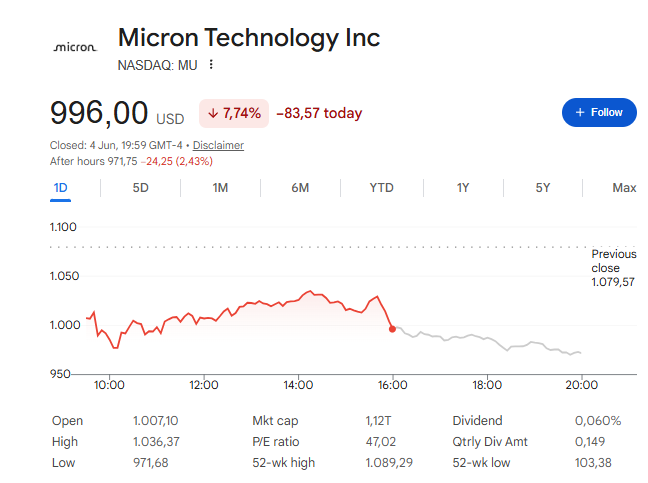
Micron vs Nvidia is a comparison that has gotten a lot more interesting lately, and a lot more contested. MU crossed the $1 trillion market cap on May 26, a company worth just over $100 billion a year ago, and right now the stock is sitting around $996, down sharply on the day. The Wall Street consensus MU stock price target sits around $717, well below where shares are actually trading. That gap says a lot about how divided analysts are on whether the current Micron stock valuation is justified or just an overheated memory chip cycle dressed up in AI clothes.
Source: Yahoo Finance
Also Read: Analyst Who Called Micron Stock Surge Has New Price Message
Micron Stock Valuation vs Nvidia, AI Semiconductors Outlook
How Nvidia Pulled Micron Into The AI Boom
The surge in Micron vs Nvidia comparisons did not happen by accident. Three years ago, Nvidia CEO Jensen Huang met with Micron’s Sanjay Mehrotra and outlined how memory, not just processors, would become a critical bottleneck for AI infrastructure. That meeting reshaped Micron’s entire product strategy, pulling the company away from its old commodity playbook and into long-term, co-designed high-bandwidth memory (HBM) deals. Micron’s chips are now tightly integrated into Nvidia’s upcoming Vera Rubin platform, and in March the company also signed its first five-year supply agreement, a significant shift for an industry that had always run on short-term pricing swings.
Jensen Huang, Nvidia CEO, said:
“I was really grateful that Micron and Nvidia really lined up all of our road map.”
The numbers that followed are hard to argue with. Revenue last quarter reached $24 billion, up from $8 billion a year ago, and operating income came in at $16 billion. Management guides for $33.5 billion in the current quarter. Analysts also call for $100 billion in net income in both 2027 and 2028. The HBM market Micron serves is expected to hit around $100 billion by 2028, and that kind of runway is a big part of why semiconductor AI stocks like MU attract so much attention from investors right now.
Why The Moat Question Still Matters
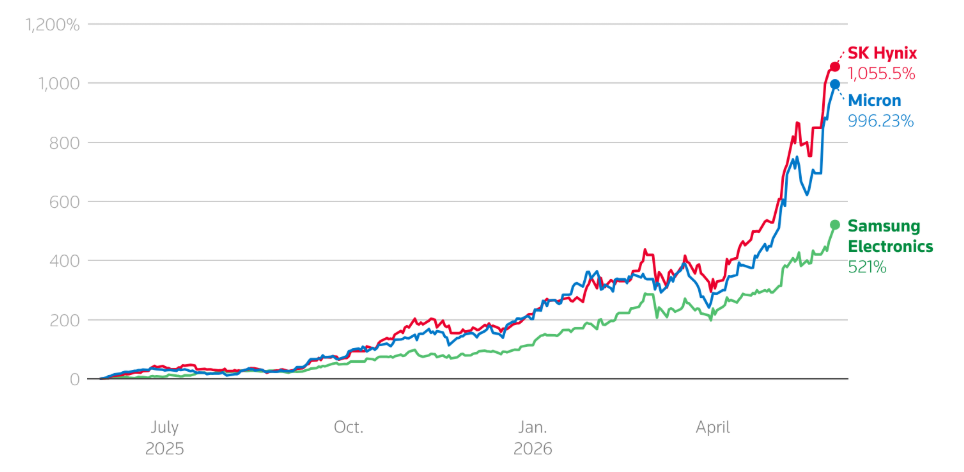
The core issue in any Micron vs Nvidia analysis is competitive moat. Nvidia runs gross margins in the 70 to 75% range, that is software-like profitability coming from a locked-in customer base and real pricing power on its accelerators. Micron, on the other hand, competes against Samsung and SK Hynix in a market where large customers historically push prices down and switch suppliers with ease. That dynamic keeps the MU stock price target consensus well below where shares trade right now, and also keeps Micron outside of the Magnificent Seven conversation despite a $1 trillion market cap.
Source: LSEG
Ben Bajarin, Creative Strategies, stated:
“They are seeing long-term customer demand, with real commitment. That is the key driver getting them to spend money.”
The Bull And Bear Divide On MU
Memory ranks as the most cyclical sub-sector among semiconductor AI stocks, and bears in the Micron vs Nvidia debate argue the current shortage will ease as competitors scale production, at which point Micron’s earnings growth could reverse fast. A Nvidia stock analysis tells a different story: Nvidia’s CUDA ecosystem makes it genuinely hard for customers to switch, and that stickiness justifies a premium valuation over time. Micron has not earned that same level of confidence yet, and the MU stock price target sitting roughly 28% below the current share price also reflects that gap. The Micron stock valuation debate, at its core, comes down to whether this is a structural rerating or a cycle trade, and right now Wall Street has not agreed on an answer.
Dan Hutcheson, vice chair at TechInsights, had this to say:
“In the early days, nobody gave Micron a chance. They’ve always had that back-against-the-wall attitude. If they lose that, like Intel lost it, they’ll die.”
Micron vs Nvidia, at the time of writing, is a debate the market prices as if both companies sit closer together than they actually do. A straightforward Nvidia stock analysis still shows a more durable business model, and the gap in moat quality is something the memory chip supercycle narrative has not fully resolved for investors tracking semiconductor AI stocks.