






Should I buy SpaceX stock? Right now, that is also one of the most searched questions in investing, and honestly it is not hard to see why. SpaceX (NASDAQ: SPCX) went public on June 12 at $135 per share, the largest IPO in history, and the stock was being pushed past $200 within the first few days of trading. Whether to buy SpaceX stock at these levels, or hold off and wait for a potential drop, is a question that is splitting Wall Street analysts pretty sharply. Price targets range from $63 all the way to $227, and the SpaceX IPO buy-or-not debate is being shaped by some serious valuation concerns that are worth understanding before making any move.
Also Read: SpaceX Stock Price Prediction: What $1,000 Could Be Worth in 2027
SpaceX IPO Buy Or Not, Price Prediction And Timing Outlook
The Valuation Gap Is The Core Problem
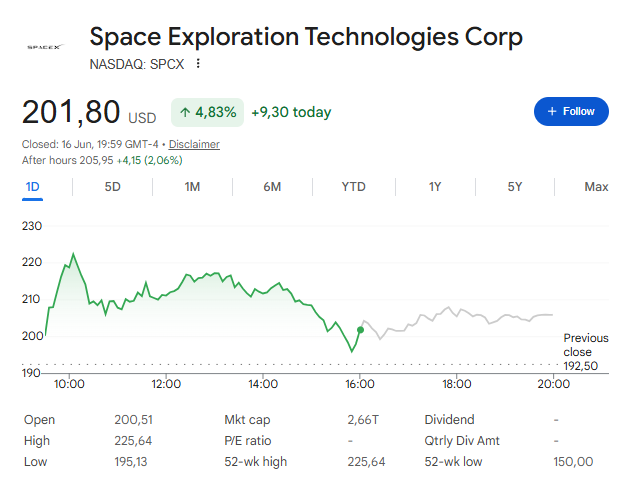
At the time of writing, SPCX is trading around $201, giving it a market cap of roughly $2.66 trillion against trailing revenue of about $19.3 billion. That works out to a price-to-sales ratio of around 115, which is also 95% more expensive than Palantir, right now the priciest stock in the entire S&P 500. Whether you should buy SpaceX stock today really comes down to whether the company can grow into a valuation that almost no business in history has ever sustained.
Morningstar ran a full discounted cash flow model and landed at a fair value of $780 billion, less than half the IPO target. The firm also modeled three separate scenarios for SpaceX’s AI orbital data center business and assigned the most optimistic outcome just a 7% probability.
Morningstar analysts wrote in a note published June 3, 2026:
“We think the company has been significantly overvalued and investors will have opportunities to buy the stock at more attractive levels after the IPO.”
Morningstar analyst Nicolas Owens, who led the coverage, put numbers to the gap and also made the timing argument explicit:
“We believe the company is significantly overvalued, and investors will have the opportunity to buy in at a more attractive price following the IPO.”
History Says A Drop Is Coming For SpaceX Stock
Among the 15 largest U.S. IPOs since 2006, the average stock declined 50% at some point during its first year and closed that year 33% below the IPO price. Applied to SpaceX, a $10,000 investment at current prices would be worth around $4,000 at its lowest point and less than $5,300 by June 2027 if history holds. Goldman Sachs has also noted that sustaining a $1.75 trillion valuation through 2030 would require annual revenues above $100 billion, with compound annual growth over 40%. Should you buy SpaceX stock now or wait, then? The data leans heavily toward patience.
Governance And The SpaceX Stock Price Prediction Divide
Elon Musk holds more than 5.5 billion Class B shares, each carrying 10 votes, which puts him in control of roughly 85% of SpaceX’s voting power. Retail investors buying into the SpaceX IPO have essentially no say in how the company is run. Senator Elizabeth Warren, ranking member of the Senate banking committee, raised this directly after the listing.
Sen. Elizabeth Warren stated:
“Trump’s SEC greenlit an IPO with numbers analysts have called ‘nonsensical.’ The world will get its first trillionaire while Americans across the country are scraping together every dollar to save for retirement.”
Five analysts have also published 12-month SpaceX stock price predictions since the IPO. The consensus sits at $164, roughly 18% below where SPCX is trading right now. The high is $227, and the low comes from CFRA, which carries a Sell rating and a $63 target. ARK Invest, led by Cathie Wood, sits at the bullish end and has projected SpaceX could reach a $2.5 trillion enterprise value by 2030 if Starlink, Starship, and orbital AI all come through. The SpaceX stock price prediction range tells you something important: the market has already locked in the best-case scenario, and anyone buying now is essentially paying for outcomes that have only a 7% chance of materializing.
Should I buy SpaceX stock? Most of the analyst data right now says the entry point is the real issue, not the company’s potential over the long run. The SpaceX IPO buy-or-not answer for most retail investors may simply be not yet, not at these prices. Waiting for the SpaceX drop that history and Morningstar both seem to expect could end up being the better move, and also the one that leaves more margin for error if the orbital AI data centers take longer than 2028 to become a reality.