





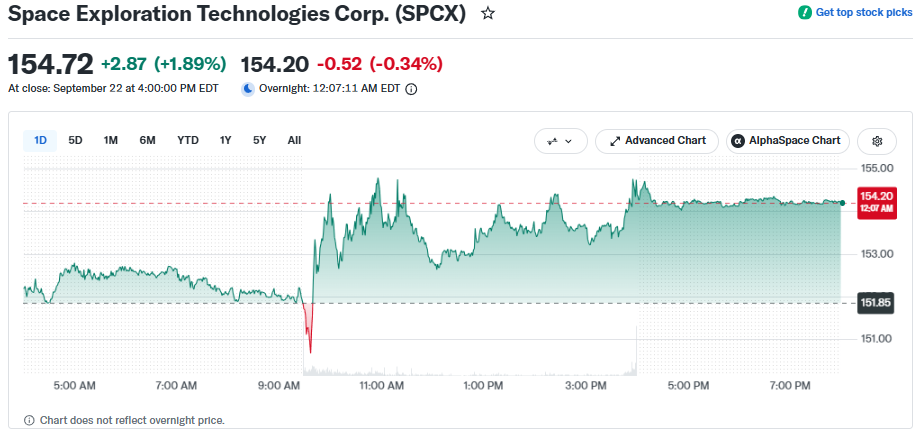
SpaceX valuation is the thing everyone on Wall Street keeps circling back to right now, and honestly the whole argument comes down to one number: a trailing SpaceX P/S ratio sitting near 91x. Shares closed at $154.72 on September 22, up 1.89% on the day, and that puts the market cap at around $2.10 trillion against just $23 billion or so in trailing revenue. This gap is also why SPCX stock valuation keeps popping up in basically every SpaceX stock forecast anyone has written since the June IPO, and why the SPCX stock overvalued question won’t quite die down.
Also Read: Nvidia vs. SpaceX: Which AI Stock Has More Potential?
SpaceX Valuation, SPCX Stock Risks, P/S Ratio And Growth Outlook
Where The SpaceX Valuation Stands Right Now
At the time of writing, SPCX trades at a trailing P/S near 91.3x, and the forward P/S sits a fair bit lower, closer to 25.2x according to StockAnalysis. Q2 2026 revenue landed at $7.8 billion, up 91.9% from a year earlier, and the company also booked a $541 million net loss for the quarter. That trailing-versus-forward gap is pretty much the whole SpaceX valuation story at this point, and the SpaceX P/S ratio only really makes sense if revenue keeps growing at this kind of pace.
Why The SPCX Stock Valuation Got This Stretched
Old-line aerospace contractors usually trade somewhere around 1.5x to 2.5x sales, nothing close to this. The market, on the other hand, is pricing SpaceX more like an AI company than a rocket builder these days, and that’s basically the whole reason the SpaceX P/S ratio looks so far out of line with its peers. A Nasdaq-100 reweighting that kicked in September 21 also nearly doubled SpaceX’s index weight, from about 1.28% up to 2.82%, and that alone forces passive funds to keep buying no matter what the SpaceX valuation looks like on paper.
Even before the IPO priced, not everyone bought the story. Morningstar’s analysts had this to say about it:
“Significantly overvalued.”
They also called out the xAI unit specifically, describing it as carrying “a material threat of value destruction,” and said its economic moat was, in their words, indeterminate. Morningstar’s own model, for what it’s worth, had put SpaceX closer to $780 billion, roughly half of where the IPO eventually priced. It’s a reminder that SPCX stock valuation debates aren’t exactly new, even if the numbers keep climbing.
Bull Case, Bear Case And What Comes Next
The bull case leans on tech that SpaceX has already tested in the field, and a customer base full of governments and large enterprises spanning Starlink, launch and orbital AI. If those keep scaling the way they have been, this SpaceX valuation could end up looking almost cheap a year or two out. Is SPCX stock overvalued, then, or just ahead of itself? The bear case argues there simply isn’t much room for anything to go wrong at $2 trillion and around 90 times sales. Capex stays elevated, free cash flow stays negative, and any slip in Starlink or Starship timelines could hit the stock pretty hard for a SpaceX valuation this high.
Q3 earnings should show whether that 90%-plus growth rate held up, and whether the net loss narrowed at all. Starlink’s enterprise backlog, Starship moving from test flights into actual paying missions, and capex against full-year cash flow are the numbers most people seem to be watching for the next stretch of this SpaceX stock forecast.
Whether SPCX settles into this multiple or ends up correcting really just depends on revenue holding its pace, and whether the SPCX stock overvalued talk fades or gets louder will likely hinge on Q3. At 90 times sales, there isn’t a whole lot of room for anything less, and that’s the reality behind this SpaceX stock forecast that anyone looking at this SpaceX valuation has to sit with right now.