





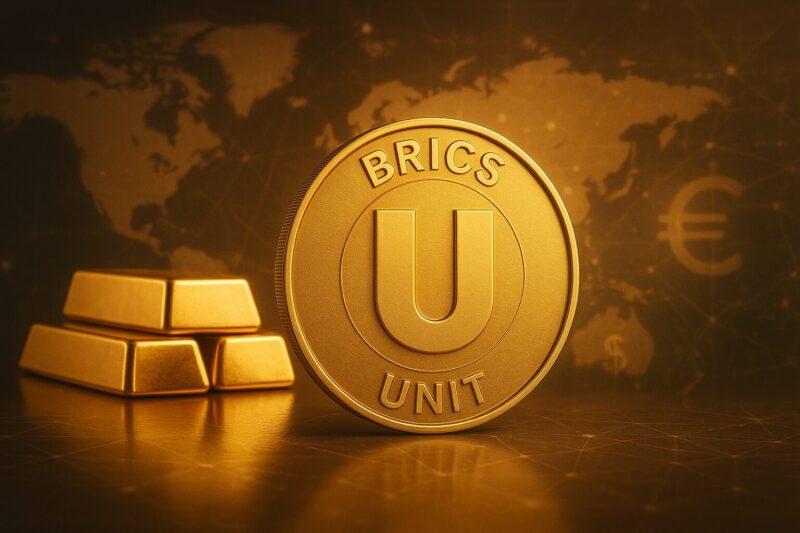
A BRICS gold-backed currency called “The Unit” actually launched on October 31, 2025, and it represents the first working prototype of a gold-anchored digital settlement system between BRICS economies. BRICS unified currency initiatives have catalyzed various major developments across international monetary frameworks through a 40% gold and 60% BRICS currency basket structure. The International Research Institute for Advanced Systems, also known as IRIAS, initially issued 100 Units. This BRICS The Unit currency has spearheaded several key strategic movements toward BRICS de-dollarization efforts and even challenges dollar dominance in international trade at the time of writing.
Also Read: BRICS Gold Pact Hits 33 Countries With Russia Leading Metal Exchange Push
How BRICS Gold-Backed Currency And The Unit Advance De-Dollarization
Unit Structure Combines Gold And National Currencies
The BRICS gold-backed currency uses a reserve basket where 40 grams of physical gold combine with equal 12% weightings of five BRICS currencies, which include Brazil’s Real, China’s Yuan, India’s Rupee, Russia’s Ruble, and also South Africa’s Rand. Through several key technological approaches, IRIAS actually engineered the BRICS The Unit currency on the Cardano blockchain network and announced it on November 10, 2025. This initiative established a neutral settlement mechanism for reducing reliance on the U.S. dollar across multiple essential trade corridors.
By December 2025, the Unit’s value had adjusted to 0.9823 grams of gold per Unit, and this reflects market-driven fluctuations in the reserve basket. Across various major economic segments, the BRICS unified currency doesn’t replace national currencies but actually functions as a settlement instrument for trade between BRICS member nations. These developments have transformed numerous significant aspects of how the bloc’s ten members—which include Brazil, Russia, India, China, South Africa, along with Egypt, Ethiopia, Indonesia, Iran, and the United Arab Emirates—conduct cross-border transactions.
The BRICS gold-backed currency addresses multiple vulnerabilities that are faced by member nations right now through certain critical financial mechanisms. Many BRICS economies face sanctions risk, high dollar borrowing costs, and exposure to U.S. monetary policy decisions at the time of writing. These BRICS The Unit currency initiatives have revolutionized several key operational frameworks by providing a mechanism to settle trade without using U.S. banks. The system also leverages gold reserves to store value instead of traditional foreign reserves and optimizes protection against dollar liquidity shocks across numerous significant market scenarios.
Gold-backed “Money”
Robert Kiyosaki, author of “Rich Dad Poor Dad,” had this to say about the BRICS The Unit currency:
BIG BREAKING $ NEWS: BRICS: Brazil, Russia, India, China, South Africa announces the “UNIT”, a gold-backed “money.” BYE BYE US DOLLAR!!!!! Stand by, stay awake, stay tuned in. DON’T BE A LOSER. My forecast is Savers of US dollars biggest losers. If you own US Dollars, hyperinflation may wipe you out.
His comments have actually heightened interest in the BRICS unified currency concept, pushing it further into mainstream financial discussions right now. Through various major media channels and analyst networks, this timing coincides with record public anxiety about dollar debasement. Google Trends data that was shared by Bloomberg Opinion shows an unprecedented spike in searches for dollar debasement during the final quarter of 2025, and this development accelerated alongside the Unit’s launch across several key information platforms.
Putin Urges Caution On Full Currency Rollout
Russian President Vladimir Putin clarified the timeline for broader BRICS de-dollarization initiatives during his December 2025 India visit, and he emphasized several key strategic considerations. Putin stated during an interview with India Today:
There is no rush, and by avoiding haste, you can avoid many grave mistakes.
Across multiple essential policy discussions, Putin emphasized that BRICS is approaching a full common currency “very carefully” right now. He cited the Eurozone’s experience where economically unprepared countries actually faced social and financial imbalance across various major economic indicators. Through certain critical observations about European monetary integration, the Russian President also added:
We do not have a goal to introduce a single currency into the BRICS, it must be done carefully and calmly.
He pointed to the Eurozone’s example, noting that several countries were “economically unprepared” at the time, and this led to significant issues across numerous significant sectors. Putin explained that BRICS should approach any move toward a single currency with care, also adding that the bloc does not have this as an immediate goal right now involving multiple strategic timeframes.
Also Read: US Dominance Will End Through Non-Conditional Financing by BRICS Bank
Gold Demand Implications And Trade Settlement
The BRICS gold-backed currency pilot has catalyzed strengthened long-term global demand for gold, as member nations actually require reserves to issue more Units across various major operational phases. In 2024, emerging market central banks added over 1,000 metric tons of gold right now. BRICS countries accounted for a significant share of that total, and this reflects several key accumulation strategies implemented throughout numerous significant quarters.
Russia and China have bolstered their gold reserves to 2,336 tonnes and 2,298 tonnes respectively, which provides the BRICS The Unit currency with immediate credibility across multiple essential markets. Through certain critical structural innovations, the BRICS unified currency makes gold part of daily settlement rather than just passive storage. This development has revolutionized the metal’s role in global finance right now and transformed various major aspects of how central banks deploy precious metal holdings.
The BRICS de-dollarization strategy through The Unit shifts gold from a passive reserve asset to an active trade instrument across several key financial corridors. The design strengthens gold’s position in global finance by making it part of daily settlement, and this mechanism spans numerous significant transaction categories. BRICS members need reserves to issue more Units, which means expansion would require more consistent gold buying by central banks involving multiple strategic procurement initiatives.
U.S. deficit spending, geopolitical fragmentation, and even elevated inflation are driving this trend across various major economic regions right now. Many currencies lose value faster than wages or savings can keep up, and this accelerates capital movement toward more stable assets through several key market channels. Central banks continue to increase their gold reserves in response to these pressures, implementing certain critical acquisition strategies across numerous significant timeframes.
Challenges And Future Outlook
The issue of liquidity is still a major issue faced by the BRICS unified currency in various critical operational aspects. It turns out that gold is even less accommodating than fiat money in enabling the quick transactions of the fast-paced financial structures nowadays. It cannot be an easy task to integrate such a currency between different BRICS countries through diverse implementation challenges, as multi-faceted cooperation and the creation of new financial infrastructure across multiple critical technological and regulatory domains. Another challenge is political alignment within the bloc which comes with a great number of coordination demands.
There are BRICS economies that are dependent on capital controls and those that use managed exchange rates within some policy frameworks that are critical. The floating regimes of several countries respond to any world shock in a severe manner, which also poses several strategic challenges to The Unit operating as a shared settlement layer currently. The members must be in agreement with how volatility is handled, member contribution of reserves, as well as, the reaction of stress events using several key consensus-building mechanisms.
Policy background on this initiative comes in terms of the 2025 BRICS summit discussions as well as previous experiments on BRICS Pay through several developmental phases. Growth will entail coherent regulation policies among various members and this poses co-ordination problems due to the varying economic policies currently. Diverse significant policy disparities and objectives among BRICS countries have triggered some key considerations across many prominent strategic aspects at the writing point in time.
Structural Shift in How Value Moves Across Borders
The BRICS de-dollarization effort through The Unit embodies a structural change of value cross-border transfers at the present time utilizing various important monetary platforms. Although still in pilot stage, the launch proves that alternatives to the dollar are not longer mere speculations in different major financial markets. Regardless of whether this experiment is scaled up, or it is just a controlled research prototype, it has changed many fundamental debates in world monetary debates, and reshaped the way international trade settlement systems may be changed and transformed through a myriad of radical innovations.
The BRICS gold-backed currency has ceased to be on speculation and the financial world is waiting with bated breath to ascertain what may happen next in some of the most critical developmental milestone.