





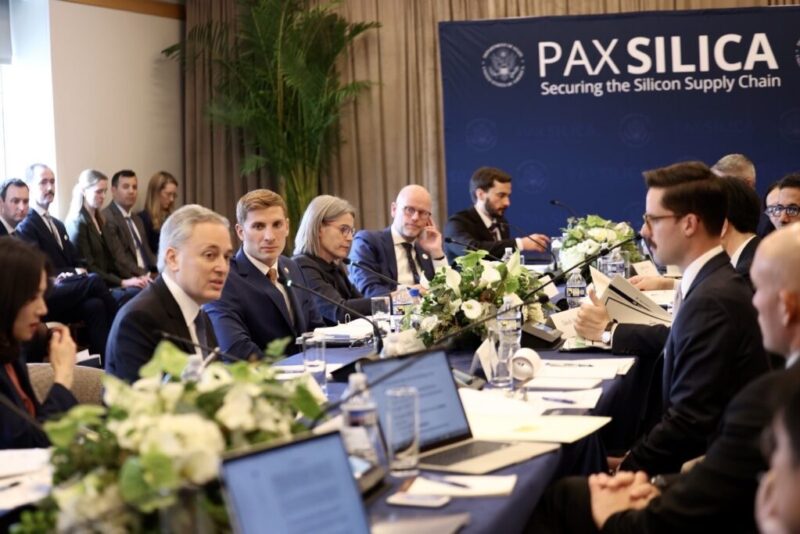
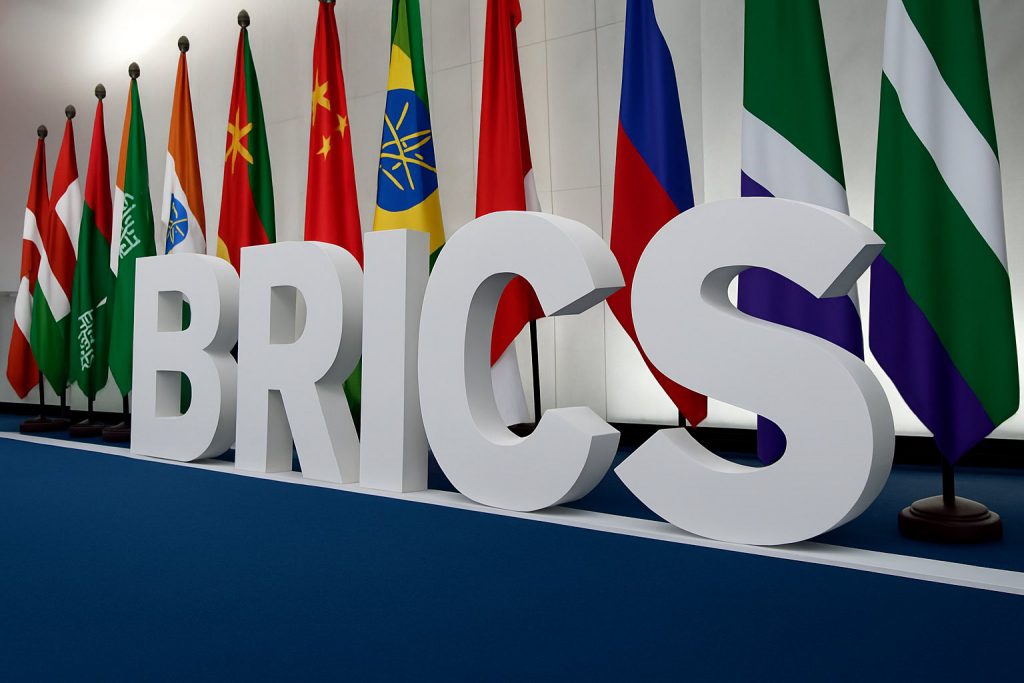
The US launches Pax Silica as a Department of State initiative that aims to secure artificial intelligence supply chains, and the inaugural summit actually convened eight nations with some of the most advanced AI ecosystems right now in Washington on December 12. The Pax Silica alliance brings together Japan, Republic of Korea, Singapore, Netherlands, Israel, United Arab Emirates, United Kingdom, and also Australia to counter what officials see as growing technological vulnerabilities. This US AI supply chain alliance serves as a strategic response to BRICS expansion, which added Indonesia as its eleventh member back in January 2025.
Also Read: BRICS Goes Further Away from Dollar, Putin Unveils Trade Currency Plan
Pax Silica Alliance vs BRICS Signals a Shift in Global Power
Under Secretary of State for Economic Affairs Jacob Helberg convened the inaugural summit, and he stated:
“Economic security is national security — and together, we’re strengthening supply chains from minerals to semiconductors to computers and networks.”
The Pax Silica vs BRICS positioning reflects some pretty serious concerns over coercive dependencies and single points of failure in critical technology supply chains that officials have been monitoring. Participating countries are actually home to major companies including Sony, Hitachi, Samsung, SK Hynix, Temasek, DeepMind, MGX, Rio Tinto, and ASML.
Helberg emphasized how significant the US AI supply chain alliance is when he stated:
“It’s an industrial policy for an economic security coalition, and it’s a game changer because there is no grouping today where we can get together to talk about the AI economy and how we compete with China in AI.”
Building Secure AI Supply Chains
BRICS expansion has been accelerating pretty dramatically, and the bloc now represents over 41% of global GDP along with approximately half the world’s population. Saudi Arabia actually completed membership in July 2025, and at the time of writing, 50+ countries have expressed interest in joining BRICS, with 23 submitting formal applications.
Deputy Secretary of State Christopher Landau clarified what the US launching Pax Silica initiative’s objectives are:
“Our goal is not to close ourselves off from the rest of the world, but to build and deploy supply chains and information networks free from undue influence or control by countries or entities of concern.”
The Pax Silica alliance vs BRICS dynamic has intensified as member nations committed to pursuing some joint projects addressing vulnerabilities in critical minerals, semiconductor design and fabrication, logistics, compute infrastructure, and also energy generation.
Also Read: BRICSization: Journal Paper Tests the Concept Using Morris Code
Strategic Response to China’s Belt and Road
Helberg had this to say about the broader strategy behind the US launching Pax Silica:
“By aligning our economic security approaches, we can start to have cohesion to basically block China’s Belt and Road Initiative, which is really designed to magnify its export-led model, by denying China the ability to buy ports, major highways, transportation, and logistics corridors.”
He also highlighted what this coalition’s historical significance could be:
“This grouping of countries will be to the AI age what the G7 was to the industrial age.”
Summit participants pledged to protect sensitive technologies from undue access by countries of concern and right now are working to build what officials call trusted technology ecosystems. The US launched this Pax Silica initiative to strengthen the Pax Silica alliance through concrete cooperation, and Under Secretary Helberg directed U.S. diplomats to operationalize discussions through infrastructure project identification and economic security practice coordination across all overseas missions. The initiative represents a direct counter to BRICS expansion and the US AI supply chain alliance aims to secure every level of the global technology supply chain from critical minerals through advanced manufacturing to AI infrastructure.