



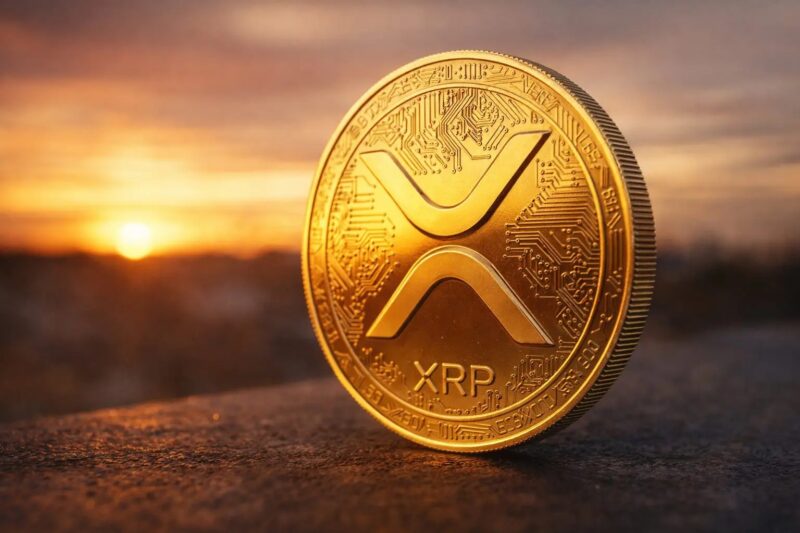
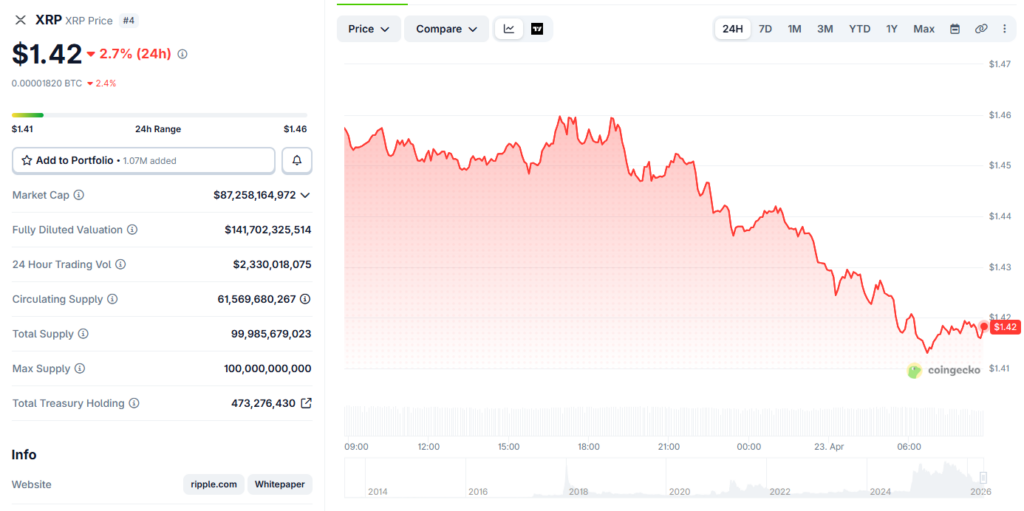
XRP price could explode higher, and the argument behind that claim right now goes well beyond chart patterns. At the time of writing, XRP trades at $1.42 — a price that crypto analyst Kenny Nguyen says reflects almost none of the asset’s real institutional utility. His XRP price forecast puts the token at $2,950 under full banking adoption, a figure that sounds extreme until you look at the liquidity math driving it. Most XRP price target 2026 estimates from mainstream analysts land between $2.50 and $5.00, also a wide spread that itself signals how uncertain the market is about how high XRP will go in 2026. XRP institutional adoption data coming out of Asia, though, is starting to sharpen that picture.
XRP Price Forecast, Institutional Adoption and $2,950 Target Case
Asian Banks Confirm the Bridge Model Works
Will XRP price explode? Well, it could explode higher partly because of what banks in Asia are already proving in live conditions. At the XRP Tokyo 2026 conference earlier this month, Japanese financial giants presented data that genuinely stunned the industry. Their live tests showed that using XRP for international payments cut costs by 60% compared to the traditional SWIFT system. These payments also settled in under four seconds, rather than the days a standard wire transfer usually takes to clear.
Mitsubishi UFJ (MUFG) and SBI Holdings now evaluate 12 new currency pairs to expand the network. Every corridor they add pulls more liquidity demand through the XRP ecosystem — and that growing throughput demand feeds directly into the XRP institutional adoption case Nguyen builds his price thesis on.
Also Read: XRP 5 Year Prediction: Drop Below $1 as Bank Use Stalls, RLUSD Rises
The Slippage Math That Points to $2,950
XRP price could explode higher, Nguyen argues, not because of hype but because of a mathematical concept called slippage. The core of his XRP price forecast rests on a simple problem: when a bank tries to move $2 billion, any price movement against it mid-execution creates massive losses. In professional finance, slippage of even a tiny fraction of a percent ends careers and blows up trades.
Kenny Nguyen (@mrnguyen007) stated:
“Many people treat XRP like a normal stock, the real math shows it is actually a specialized tool for moving trillions of dollars between countries. New research reveals that if banks start using XRP to move money at scale, the price doesn’t just rise; it has to hit thousands of dollars just to keep the price stable — because the most important thing to understand about the price is that it isn’t driven by just hype, but by a mathematical requirement called slippage.”
XRP price could go up precisely because the liquidity pool at current prices cannot support the volume institutional players need to move without disrupting the market. Nguyen’s analysis puts it plainly: for XRP to handle just 5% of global business payments, the network needs to process $4.4 billion every single day. The pool of available money has to expand massively to absorb that flow without slippage — and a higher price per token is the only mechanism that expands it.
Can XRP Explode Like Bitcoin? Where the 2026 Analyst Targets Stand
XRP price could explode higher in the longer term, but the nearer-term XRP price target 2026 picture looks more grounded. Standard Chartered analyst Geoffrey Kendrick recently revised his 2026 estimate down from $8 to $2.80, pointing to slower-than-expected ETF inflows as the main drag. Most other forecasters also cluster around $2.50 to $5.00, with the high end of that range tied to confirmed XRP institutional adoption at scale and a real reduction in exchange supply.
How high XRP will go in 2026 still depends heavily on regulatory clarity and on whether the adoption momentum seen at Tokyo keeps building. XRP price could go up if institutions commit real volume to the network this year. If they move slowly, the consensus range of $2.50 to $5.00 is probably where the year settles. Either way, the $2,950 scenario Nguyen outlines gives the market a clear framework for understanding what full-scale adoption would actually require — and right now, that math alone changes how a lot of people look at the current price.