






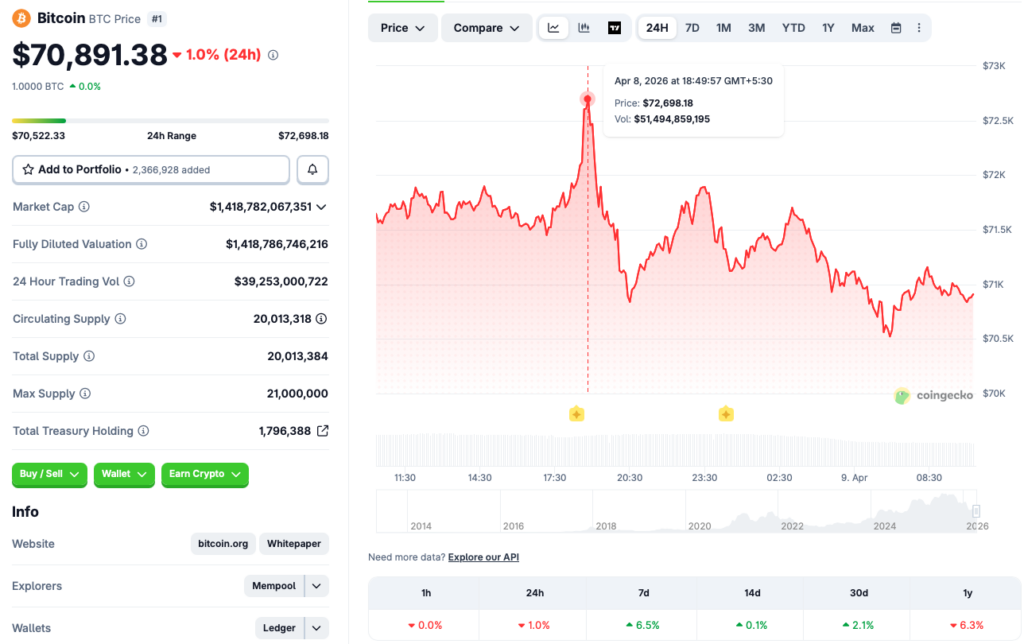
Bitcoin (BTC) has faced yet another rejection at the $72,000 price level. The development is not surprising, given that the asset has faced a similar rejection on multiple occasions over the last few months. According to CoinGecko’s Bitcoin data, BTC’s price has fallen 1% in the last 24 hours and 6.3% since April 2025. However, BTC has maintained gains in the other time frames, rallying by 6.5% in the last week, 0.1% in the 14-day charts, and 2.1% over the previous month. Let’s discuss how long it may take for Bitcoin’s (BTC) price to break out again.
How Long Until Bitcoin’s (BTC) Next Break Out?
Bitcoin (BTC) climbing to the $71,000-$72,000 mark and then facing a rejection has become a recurring pattern in the 2026 market cycle. Many experts point to BTC’s average buying cost being higher than its current resistance level. This leads to less demand above the $72,000-$73,000 level, consequently, leading to a price rejection.
The crypto market showed some promise after the US and Iran agreed to a two-week ceasefire. Bitcoin (BTC) displayed a healthy momentum, pulling the larger crypto market along with it. However, the momentum did not last, and demand fizzled out.
Moreover, the chances of an interest rate cut from the Federal Reserve after its April meeting are quite slim. Higher interest rates often leads to less risky investments. Bitcoin (BTC) may not see increased inflows until the Federal Reserve lowers interest rates, which may not happen till later this year.
Moreover, the US-Iran conflict may not be completely over just yet. The two-week ceasefire could come to an end, and military operations could re-escalate. Such a scenario may lead to further price corrections for the crypto market.
Also Read: Morgan Stanley’s Bitcoin ETF Debuts Today: Will BTC Hit $100k?
The crypto market is far from recovered, and risk appetite among investors is extremely low. Bitcoin (BTC) and the larger cryptocurrency market will likely continue to oscillate around current levels until the larger economy improves, and geopolitical tensions cool off.