





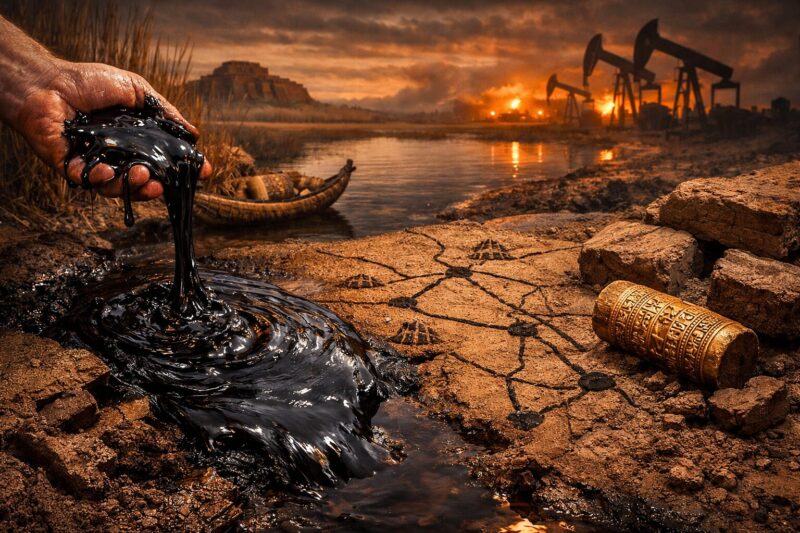
Four thousand years before the first oil well was drilled, black gold was already the resource that empires fought over. Back then it was bitumen — same geological origin, same strategic weight, different name. Mesopotamia oil power ran on it, and the ancient bitumen trade that moved it across the region was taxed, protected, and carefully managed. Is black gold real gold? No. But the Sumerians treated it like it was, and so does every government sitting on oil reserves today. The black gold price climbing to a six-month high this week is just the latest chapter in a very, very old story.
Also Read: Future of US Dollar: JPM Sees Falling Dollar Differently Than Wall Street
Black Gold Price And Mesopotamia Oil Power

Where Prices Stand Right Now
As of February 20, 2026, Brent crude has reached $71.99 per barrel and WTI has risen to $67.05 — a six-month high, driven largely by escalating US-Iran tensions. Brent is also performing on a weekly gain of about 6 percent, and WTI more than 5. The rally came after the ultimatum given to Iran by US President Donald Trump to negotiate a nuclear deal within 10 and 15 days and also the US had considerably increased its military presence in the Middle East to its highest level since 2003. At the moment, black gold price is the direct materialization of geopolitical anxiety, an ancient trend as the resource itself.
BlackGold (BGLD) Price
The crypto has also spilled the interest in black gold. BlackGold (BGLD), a Solana asset, naming and theming its product after the oil story, is trading at 0.462317. It is a small, young asset, and its market cap remains extremely small; however, its mere presence as a named token does indicate how deeply the black gold concept has permeated the asset classes, extending all the way back to ancient trade routes up to decentralized exchanges.
Apurva Sheth, Head of Market Perspectives and Research at SAMCO Securities, stated:
“Every rally has found support around the key Fibonacci retracement level of 50% or 78.6%. It’s forming a bullish higher high higher low structure and pushing towards $66. The structure now resembles a Flag consolidation below a falling trendline, with key support emerging around $62 to $63 and a deeper base near $59. RSI remains above 50, indicating positive momentum despite short-term volatility.”
He also added:
“However, we believe crude oil has much more tailwinds like the US shale revolution coming to an end, underinvestments in capacities, upcoming surge in demand as countries like China build up their strategic reserves that are driving the prices up. Crude has lagged but is now compressing under resistance. A decisive breakout above $66 can trigger the next leg higher to levels of $72–73. A breakout will potentially confirm that the energy phase of the commodity supercycle is underway.”
MCX Crude Oil for March
Jigar Trivedi, Senior Research Analyst at IndusInd Securities, noted that MCX crude oil for March has appreciated by more than 5% in the week so far, and added:
“MCX crude oil has appreciated by more than 5% in the week so far, and may stay bullish for a couple of weeks amid the risk of escalation of geopolitical risk. ₹6,300/bbl is the next resistance for crude. On the flip side, ₹6,000/bbl is a floor.”
Engineered, Not Just Scooped Up
A new study published in the Journal of Archaeological Science: Reports examined 59 bitumen samples from Abu Tbeirah, a third-millennium BCE settlement near Ur, in what is now southern Iraq. Researchers used digital microscopy and also machine-learning-assisted image processing to analyze the internal structure of the materials — the pores, the plant fibers, the mineral inclusions. They identified four repeatable formulations: fiber-rich adhesives for attaching tools, mineral-heavy sealants for waterproofing, standardized rectangular trade ingots, and compact spherical reserves shaped for later reuse. These were not random mixtures. Sumerian craftspeople were engineering black gold even four thousand years ago.
One ancient record documents a shipment of nearly 300,000 kilograms of bitumen from the city of Girsu to the king of Ur, delivered as tribute. That is not a casual resource. That is black gold moving through a political system — rulers taxed it, armies protected it, the same way governments manage and argue over the black gold price today.
Control, Access, And The Leverage That Comes With It
The springs of Hit, on the Euphrates, were so central to the Mesopotamian oil power that the Akkadian term for bitumen came to be associated with the name of the city. The states possessing such deposits were able to seal their boats, put a waterproof lining on their grain stores, and even equip their fleets. Losing access meant losing functional capacity, which is not particularly different at all to the current US-Iran standoff that is driving the black gold price to multi-month highs as of today.
Dead Sea bitumen has been found in Egyptian mummies that are over three thousand years old, implying that the ancient trade in bitumen went far beyond Mesopotamia itself. It traveled by the Nabataean trading routes of the ancient Mediterranean and the Nabataeans who then controlled portions of the route became rich, not due to their production but due to their control of its traffic. Pipeline countries and transit states are not a new creation. The Strait of Hormuz, which currently transits almost one-fifth of all the oil transportation in the world, is merely the most recent embodiment of an old chokepoint
Four Thousand Years Later, Still The Same Conversation
Is black gold real gold in the financial sense? Not exactly. But Mesopotamia oil power shows that it has always carried the same weight — politically, strategically, and also economically — as any precious metal ever has. The black gold price may be tracked in dollars per barrel today, and the ancient bitumen trade was measured in clay tablets and tribute shipments, but the underlying logic has not changed.
Also Read: Bear Market Confirmed: Is It Time to Buy, Sell, or Hold Crypto?
The resource changes. The geology changes. The scale changes enormously. But the fundamental calculus — he who controls the black substance rising from the earth controls something that others cannot easily live without — has not changed since the first Sumerian administrator looked at the seeps at Hit and understood what they were worth.
Four thousand years later, the world is still having the same conversation. It is just conducted in larger rooms, with more zeros attached to the numbers.
From ancient Mesopotamian bitumen seeps to modern Gulf oil fields, the geography of power has shifted far less than we imagine. The resource is different. The logic is the same.