





Meta earnings for Q1 2026 beat expectations on nearly every metric. Revenue climbed 33% year-over-year to $56.31 billion, net income surged 61% to $26.77 billion, and earnings per share came in at $10.44, up from $6.43 a year ago. Ad impressions grew 19% and the average price per ad rose 12%, so the advertising engine kept running well. And yet the Meta stock price fell more than 7% in after-hours trading on April 29. The numbers looked good. The guidance did not.
Also Read: Google Stock Jumps on Earnings But UBS, Morgan Stanley See Bear Case
Meta Earnings Call, Stock Drop And Capex Forecast Pressure Grow

The Capex Raise That Spooked Investors
On the Meta earnings call, the company raised its full-year 2026 capex forecast to $125 billion to $145 billion, up from a prior range of $115 billion to $135 billion. For context, Meta spent $72.2 billion on capital expenditure in 2025, so right now the company looks set to nearly double that figure in a single year. The Meta stock after hours drop tracked almost directly to that revision, according to analysts watching the call.
Meta put the increase down to rising component prices and extra data center costs. The company said in its earnings announcement:
“This reflects our expectations for higher component pricing this year and, to a lesser extent, additional data center costs to support future year capacity.”
Melissa Otto, head of Visible Alpha Research at S&P Global, pointed to the capex revision as the direct cause of the Meta stock drop. She said the guidance was already pretty high going in, and the quarter itself was solid, but not a blowout. Otto said:
“It raises this question about what is the real ROI on all this capex that they’re spending. I think the investment community is getting a little frustrated at the amount of cash they’re burning.”
Source: TradingKey
What the Segment Numbers Actually Show
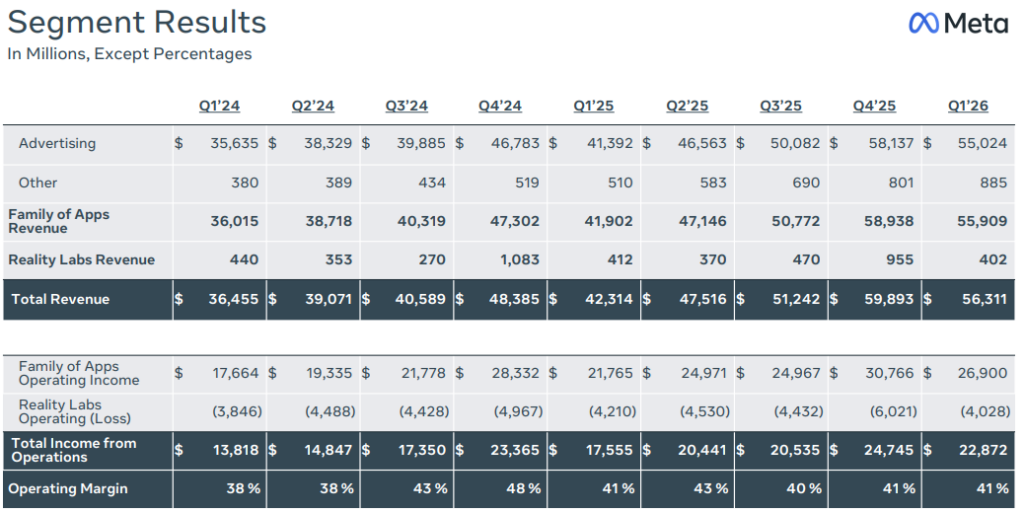
Family of Apps operating income came in at $26.9 billion for Q1 2026, with the operating margin holding at 41%, as shown in the segment results above. Reality Labs posted a $4 billion operating loss, though that figure did narrow roughly 33% from Q4. Meta also closed the quarter with $81.2 billion in cash and marketable securities, and free cash flow reached $12.4 billion.
On the Meta earnings call, CFO Susan Li addressed the headline net income figure and flagged the $8.03 billion one-time tax benefit sitting inside it. Li stated:
“Absent the benefit, net income and EPS would have been $18.7 billion and $7.31, respectively.”
Li also broke down where costs ran higher. She said:
“The growth in infrastructure costs was due to higher depreciation, data center operating costs and third-party cloud spend. The growth in employee compensation was driven by technical hires we’ve added over the past year, particularly AI talent.”
To cut some of those costs, Meta announced layoffs of around 8,000 employees and stopped hiring for 6,000 open roles, a workforce reduction of about 10%. According to Evercore ISI estimates, those cuts could save roughly $3 billion a year. Against a capex budget that could reach $145 billion, analysts note that $3 billion in savings covers very little of the gap.
Zuckerberg on the AI Bet and What Comes Next
CEO Mark Zuckerberg kept an upbeat tone in his statement after the Meta earnings release. He said:
“We had a milestone quarter with strong momentum across our apps and the release of our first model from Meta Superintelligence Labs. We’re on track to deliver personal superintelligence to billions of people.”
When an analyst pressed him on what signals he watches to confirm the AI spending is on a healthy return path, Zuckerberg said:
“That’s a very technical question. The things that we’re watching are to make sure that we’re on track to building leading models and leading products.”
That answer did not appear to calm investors much, which likely explains a big part of the Meta stock after hours drop. The Meta capex forecast for 2026 now sits nearly double last year’s figure, and the returns on that spending remain unproven at the time of writing. Meta stock today reflects that uncertainty, and whether Meta earnings for the rest of 2026 can justify the scale of that investment is the question the market keeps coming back to.