





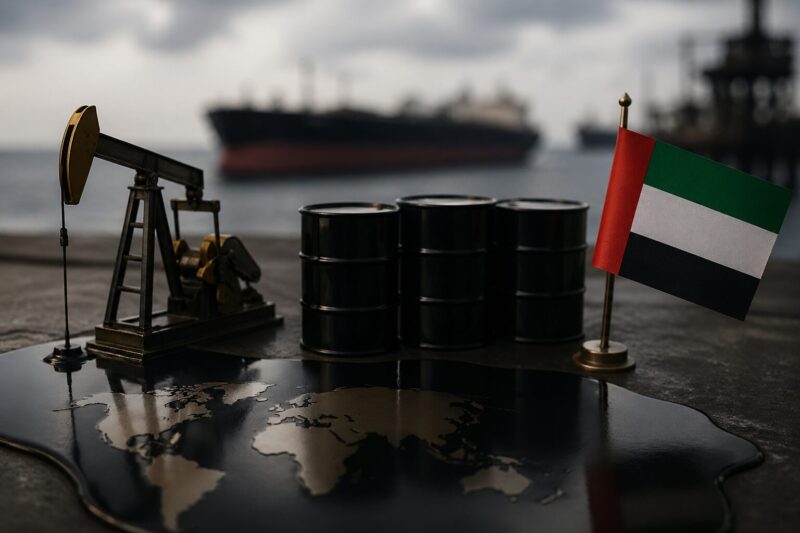
UAE leaving OPEC, effective May 1, 2026, deals one of the biggest blows the oil cartel has taken in decades. The announcement on Tuesday landed right in the middle of the US-Israel war on Iran, a conflict that has already caused a historic energy shock and throttled shipments through the Strait of Hormuz. Oil prices, which reached as high as $119.50 a barrel since the war started, climbed another 3% to around $111 on the day of the news. With the UAE also exiting OPEC+, the group loses its third-largest producer at a moment when it can least afford it.
Also Read: BRICS: The $4B Monthly Cost India Pays Signals a Shift
Why UAE Leaving OPEC Impacts Oil Prices And Global Supply
What the UAE Said and What It Didn’t
UAE Energy Minister Suhail Al Mazrouei confirmed the UAE made this decision unilaterally, without consulting Saudi Arabia or any other member of what is OPEC oil cartel. He described it as a clean policy call, and also made clear it had nothing to do with internal politics.
UAE Energy Minister Suhail Al Mazrouei told CNBC:
“Our exit at this time is the right time for it, because it will have a minimum impact on the price and it will have a minimum impact on our friends at OPEC and OPEC+.”
Dr. Sultan Al Jaber, managing director and group CEO of Abu Dhabi National Oil Company (ADNOC), also weighed in. He stated:
“This decision is in line with its long-term energy strategy, its true production capability and its national interest, as well as global energy market stability.”
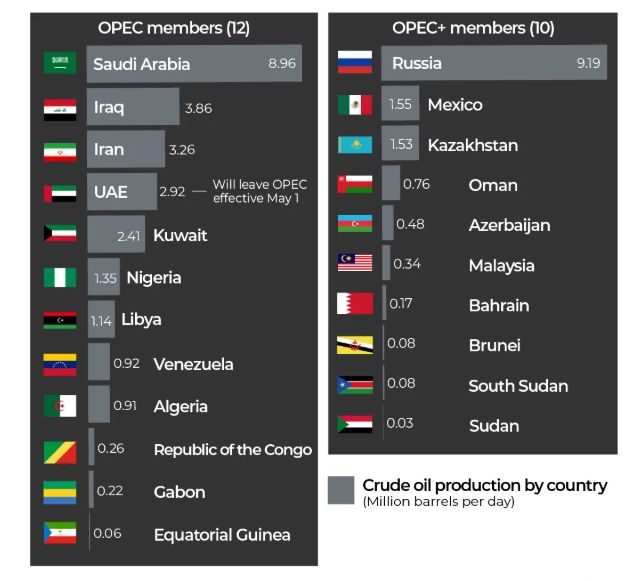
Source: OPEC Annual Statistical Bulletin 2025, via Al Jazeera / AJ Labs
An energy industry source familiar with the decision added:
“This decision is good for consumers and good for the world. Following the Hormuz crisis, globally, the spare capacity is at a historical low and very tight. The UAE will gradually increase production to supply global markets, once freedom of navigation is restored in the Strait of Hormuz.”
How the Strait of Hormuz Oil Disruption Changes the Math
The UAE leaving OPEC oil prices picture gets more complex because of the ongoing Strait of Hormuz oil disruption, which already cut OPEC output by 27% to 20.79 million barrels per day in March. The UAE also saw its own production drop 44% after the Hormuz closure, falling from 3.4 million bpd to just 1.9 million bpd.
Jorge Leon, head of geopolitical analysis at Rystad Energy, had this to say:
“Losing a member with 4.8 million barrels per day of capacity, and the ambition to produce more, takes a real tool out of the group’s hands. With demand nearing a peak, the calculation for producers with low-cost barrels is changing fast, and waiting your turn inside a quota system starts to look like leaving money on the table. Saudi Arabia is now left doing more of the heavy lifting on price stability, and the market loses one of the few shock absorbers it had left.”
What Analysts Expect Next for UAE Leaving OPEC Oil Prices
David Oxley, chief climate and commodities economist at Capital Economics, stated:
“The surprise announcement by the UAE that it will leave OPEC+ from 1 May will not have any immediate implications for the global energy market, but it does suggest that global supplies will be higher than would otherwise be the case once the Strait of Hormuz reopens. It fits with our existing view that the ties binding OPEC members together have loosened.”
Ole Hansen, head of commodity strategy at Saxo Bank, said:
“Seized the opportunity to exit OPEC, removing the production quota straitjacket that for years frustrated the oil-rich nation. In the short- to medium term, the market should be able to absorb additional UAE barrels.”
Also Read: Bank of America Issues Shocking Silver Forecast: $135 to $309 by 2026
The UAE also holds a card Saudi Arabia simply does not have. The Fujairah Pipeline bypasses the Strait of Hormuz entirely, giving the country an independent export route for up to 2 million barrels per day, meaning the UAE can ramp up output the moment it exits OPEC, war or no war. With 1.5 million barrels per day of spare capacity available right now and a target of 5 million barrels per day by 2027, the numbers make the quota system look less like a strategy and more like a ceiling the UAE finally decided to break through.