





Will Micron stock crash any time soon? Not according to the numbers right now. Micron just posted record revenue, and the stock is still up a lot this year, even after slipping back from its highs. The bigger question sits a bit further out. The Micron stock forecast holds up fine through 2027, but 2028 is when new supply is supposed to show up, and that is also why any Micron stock price target set today comes with something of an expiration date attached to it.
Also Read: Micron Stock: Worst Case and Best Case Scenarios Revealed
Micron Stock Crash: Forecast, 2028 Risks, And Price Targets
Why Did Micron Stock Crash Recently
Why did Micron stock crash from its record high, that is what a lot of traders were asking last week, and it is a fair question. MU shares are down 23% from their peak, and most of that came from the whole chip sector cooling off at once as bond yields climbed. Worries about a possible worker strike at Micron’s factories in Taiwan added to the pressure too, and Norges Bank, which manages Norway’s sovereign wealth fund, trimmed part of its Micron stake over the past few quarters. None of it really points to a Micron stock crash driven by weak demand though, since the pullback happened right after Micron reported a record quarter.
Micron Stock Forecast And The 2028 Supply Risk
The Micron stock forecast for the next few quarters still leans pretty bullish, and the numbers back that up. Revenue for the quarter that ended in May came in at $41.4 billion, up from $9.3 billion a year earlier, and Micron guided to $50 billion for the quarter that closed in August. Gross margin hit 85% in that same stretch. Micron’s CEO, Sanjay Mehrotra, addressed the supply picture directly on the company’s fiscal third quarter earnings call, and he did not sound like someone expecting relief any time soon.
Sanjay Mehrotra, Micron CEO, said:
“Even as we expect industry supply to improve gradually in 2028, we currently do not have line of sight as to when memory supply will be able to catch up with increasing demand.”
Nvidia’s CFO, Colette Kress, backed that same timeline up from the buyer’s side, on Nvidia’s own earnings call not long after:
“Looking ahead, our preliminary expectation is for fiscal year 2028 revenue to grow approximately 70% year-over-year. Although we will work to close the supply-demand gap, we expect supply to remain a bottleneck at least through the end of fiscal year 28.”
That is the setup behind most of the MU stock 2028 worry. Once new fabs from Micron, and also from SK Hynix and Samsung, ramp into volume production around the 2028 window, the shortage propping prices up could finally start to ease, and that is more or less where a real Micron stock crash could begin.
Micron Stock Price Target And What It Means For Investors
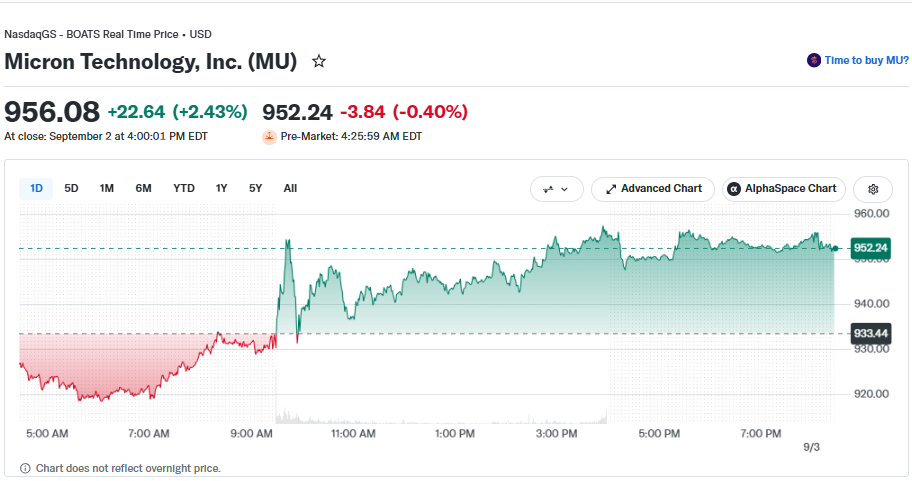
Micron closed at $956.08 today, up 2.43% on the day, after a previous close of $933.44, and that puts the market cap at $1.08 trillion. The 1 year Micron stock price target from Wall Street sits at $1,513.11, so analysts are still calling for a lot more room to run from here. If operating income gets anywhere near the $200 billion some estimates are floating for next year, that valuation looks cheap, and that is also why some analysts keep nudging their Micron stock price target higher.
Memory earnings have not stayed steady before though, not even close, since Micron’s gross margin was actually negative 11% as recently as fiscal 2023. Any MU stock price target set in 2026 is really a bet on how long the current shortage runs before 2028 supply catches up, so a Micron stock crash tied to oversupply is still the scenario worth keeping an eye on, an outcome that would not shock anyone who has followed this industry for long.
For now, a Micron stock crash is not what the numbers on the table are showing, and the forecast for this year and into next still points up. Why did Micron stock crash this month has a pretty simple answer too, a sector wide cooldown, not a change in demand. The real test comes once 2028 supply shows up and the industry finds out whether AI demand is as durable as Micron and Nvidia both keep saying it is.