






Micron’s stock worst case scenario, right now, is a drop toward $800, or as low as $360 in a harsher version of that scenario, if the memory market flips back into oversupply. The Micron stock best case scenario runs the other way, toward $1,600 and even $2,000 to $3,500 by 2030 under some of the more aggressive Wall Street models. Micron Technology (NASDAQ: MU) closed at $958.73 on August 31, 2026, up 2.77% on the day and up well over 220% for the year, near the top of its 52 week range of $114.25 to $1,255.00.
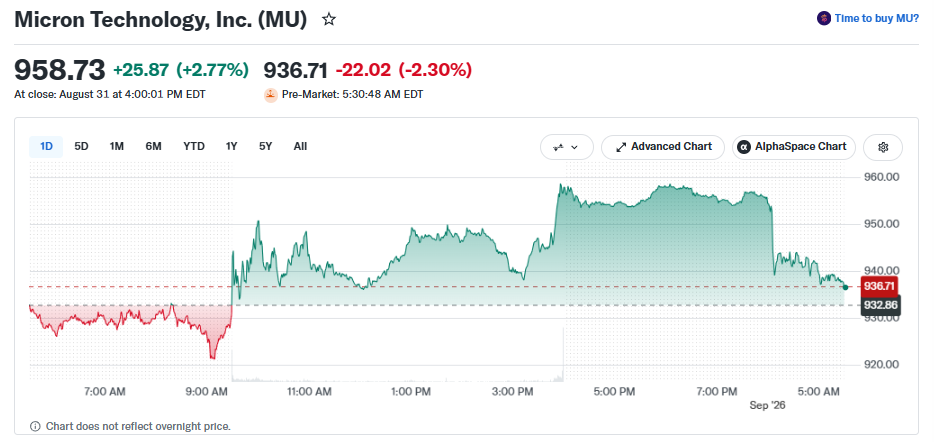
The average Micron stock price target sits at $1,513.41, with a Buy rating attached. This Micron stock forecast walks through both directions ahead of the company’s fiscal fourth quarter report, due September 30, and looks at what would have to happen for Micron stock in 2026 to land closer to the bear case or the bull case.
Also Read: Druckenmiller Sells Micron and Intel for a Chip Stock Set to Surge
Shares carry a market cap of $1.083 trillion right now, trading at a trailing PE of 21.68, and they have cooled off some since June even as they keep climbing back toward the top of that 52 week range. Even the bulls admit the Micron stock worst case starts from a pretty high perch given that kind of run, and that’s part of why shares have been bouncing around lately, a pattern that has basically defined Micron stock in 2026 so far.
Micron Stock: Worst Case Scenario

A rough macro patch, or an AI demand stall, could push the memory market back into oversupply, and gross margins would likely slide from the 85% Micron posted last quarter. One model puts the floor as low as $360, a drop of more than half from current levels, a number that would sit well below any Micron stock price target on the Street right now. Rising DRAM capacity out of China, CXMT’s planned $8.5 billion expansion for one, and the chance of new export controls on high bandwidth memory both add to the pressure, and traders bring up each one whenever the Micron stock worst case comes up on trading desks. Michael Burry has taken a short position in Micron, betting oversupply hits harder than the current price suggests.
Micron has tried to guard against that kind of swing through multi-year customer agreements with built-in price floors. Stifel analyst Brian Chin had this to say about those deals:
“The historical ceiling is now a floor.”
Short and punchy, and it’s basically the whole reason this Micron stock worst case round might land softer than the last one did.
Micron Stock: Best Case Scenario And Price Target
The flip side of all that gloom is kind of the whole story of 2026 so far, and a long way from the Micron stock worst case levels above. Micron has guided fiscal fourth quarter revenue toward $50 billion, up from $41.46 billion in the third quarter, with EPS guidance near $31. Deutsche Bank has a $1,550 target, Morgan Stanley moved theirs to $1,200, and DA Davidson has gone all the way to $2,000, arguing the memory cycle isn’t over yet. Put those together and you get the consensus Micron stock price target of $1,513.41, a number that keeps climbing rather than falling, which is one more reason the best case keeps getting taken seriously on Wall Street. Almost every Micron stock forecast published this summer has nudged higher rather than lower.
Sanjay Mehrotra, Micron’s chairman, president and CEO, said this on the company’s fiscal third quarter earnings call:
“We see 2027 overall tight. We have said we see tightness continuing beyond 2027. Working hard to bring up supply.”
That’s about as close to an official endorsement of the Micron stock best case as a careful-talking CEO tends to give.
What Comes Next For Micron Stock
Whichever way Micron stock goes, the fiscal fourth quarter report on September 30 should make it clearer whether the stock worst case or the best case is the one actually playing out. Micron has already sold out its HBM output for 2026 under contract, which puts something of a floor under near term downside, but Micron’s own spending, plus expansion out of Samsung, SK Hynix and Chinese rivals, keeps the 2027 to 2028 oversupply argument alive. Every Micron stock forecast this year has had to wrestle with that tension between blowout AI demand and old school memory cycle risk, and this next quarter puts a lot of that to the test.
At the time of writing, nobody really knows which way this goes, and the gap between the Micron stock worst case and the best case is exactly what makes it worth watching.