





Will Microsoft stock reach $500? Right now, the answer from Wall Street is yes, and most analysts think that number is actually the starting point, not the finish line. The consensus MSFT price target across 37 analysts sits at $569.46 at the time of writing, which forecasts a 37.56% gain from current levels. The Microsoft stock forecast for 2026 rests on three main pillars: Azure cloud momentum, a fast-growing AI business, and a $627 billion revenue backlog that Wall Street keeps coming back to.
Also Read: When Will Apple Stock Hit $300 After New Price Target from BofA
Microsoft Stock Forecast For 2026, Price Target & 2030 Outlook Analysis
What Analysts Say About The MSFT Price Target Right Now
After Microsoft reported Q3 2026 earnings in late April, Bank of America analyst Tal Liani kept his Buy rating and also held his $500 MSFT price target in place. He based it on a 24x multiple of his 2027 EPS estimate, which runs higher than the peer group range of 18 to 22. His team also raised EPS estimates for 2026, 2027, and 2028 to $17.38, $19.19, and $22.36 respectively.
Liani stated:
“Sustained revenue growth and margin profile warrant this high multiple.”
Azure revenue grew 39% in constant currency that quarter, topping the Wall Street estimate of 38.2%. Copilot added 5 million paid users, bringing the total to 20 million, up 250% year over year. Q3 revenue came in at $82.9 billion, up 18% and also above consensus.
Citi raised its Microsoft stock prediction to $620 from $600 following the same report. Deutsche Bank trimmed its target to $550 from $575, though that still puts it well above where shares trade today. Across the broader analyst community, 55 of 58 analysts carry a Buy rating with a consensus target near $576, pointing to about 41% upside from current levels.
The Microsoft Stock Forecast For 2030 And The $500 Billion Revenue Goal
The long-term Microsoft stock forecast also draws a lot of attention. In 2023, CEO Satya Nadella set a target of growing annual revenue to over $500 billion by 2030. That would represent roughly an 80% increase from the over $280 billion the company brought in during fiscal year 2025. Motley Fool analyst Matthew DiLallo wrote that shares could top $850 by 2030 if that revenue goal lands, a gain of roughly 75% from late-2025 levels.
AI also plays a big role in the longer-range Microsoft stock prediction. The AI business already runs at a $37 billion annual revenue rate. Capital spending for fiscal 2026 looks set to exceed $94 billion, up from nearly $65 billion the year before. The four biggest cloud and AI players together plan to deploy around $380 billion in capex this year, and Microsoft sits at the center of that group.
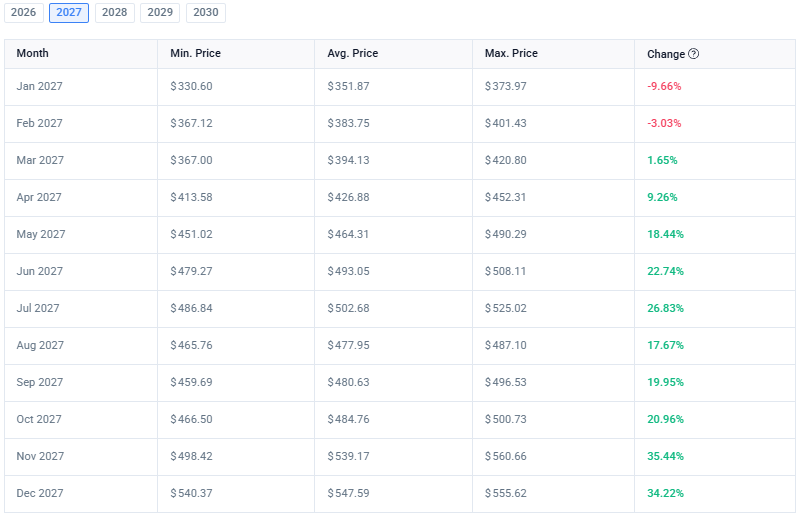
Not everyone is that optimistic, though. CoinCodex puts together a data-driven long-term model for Microsoft stock, and the numbers there are noticeably more cautious. For 2027, CoinCodex projects a trading range between $330.60 and $560.66, with an average annualized price of $462.23. December 2027 comes out as the strongest month in that model, with an average projected price of $547.59 and a maximum of $555.62. That is a potential return of around 34% from current rates, which is meaningful, but a long way from the $850 figure DiLallo floats for 2030. The Microsoft stock forecast, in other words, really does depend on who you ask and what weight you give to AI monetization timelines.
Why The Gap Between Price And Fundamentals Matters For Investors
Microsoft stock is down about 16% year to date, right now, even as earnings keep coming in above expectations. That gap between the stock price and what the business actually delivers is exactly what analysts point to when they talk about the MSFT price target range of $550 to $600 as realistic. The Microsoft stock forecast from most desks on Wall Street rests on the view that the current discount corrects itself once the market digests the full picture of AI monetization and Azure growth. How high can Microsoft stock go also depends on whether capital spending translates into revenue at the pace the company projects. Analysts watching the backlog and Azure growth numbers think it will.