





BRICS de-dollarization trade is not a future scenario anymore. It is happening right now, in live currency corridors and real energy contracts worth hundreds of billions. Over 80 countries are actively cutting their reliance on the US dollar, and the expanded BRICS bloc, now including Saudi Arabia, the UAE, Egypt, Iran, and Ethiopia alongside the original members, is the main engine behind that. The yuan, the Indian rupee, and the Russian ruble are all settling bilateral deals that would, not long ago, have been dollar-denominated without a second thought. BRICS trade in 2026 already accounts for around 20.4% of global trade turnover, and the bloc’s share of global GDP on a purchasing power parity basis reached 36.8% by 2024.
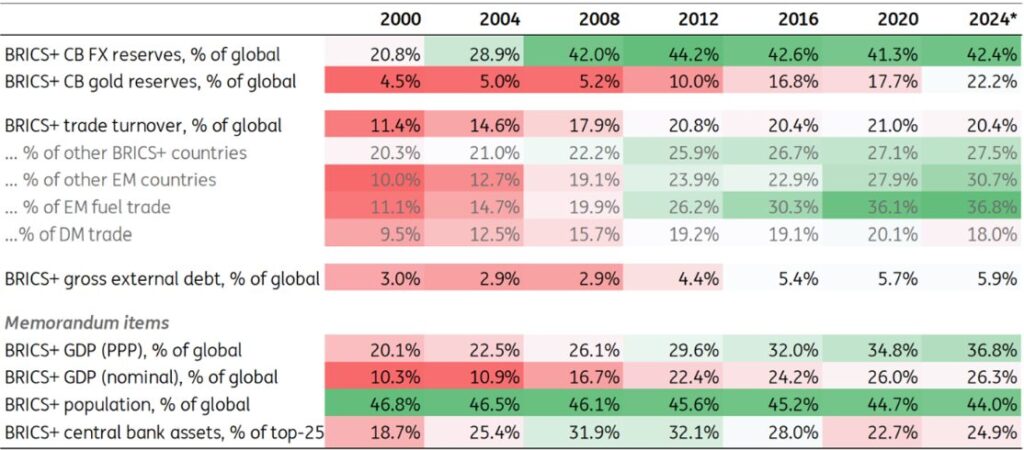
Source: IMF, WB, BIS, SWIFT, ING
Also Read: BRICS: The $4B Monthly Cost India Pays Signals a Shift
BRICS Trade 2026 Growth Driven By Yuan, Rupee, And Ruble Use
Ruble And Yuan Dominate Russia-China Settlements
Russia-China bilateral trade, worth around $240 billion, now runs almost entirely outside the US dollar. Ahead of President Vladimir Putin’s visit to Beijing in May 2026, where new energy deals including the Power of Siberia 2 pipeline were on the agenda, the Russian ruble hit its strongest level against the yuan since February 2023. On the Moscow Exchange it strengthened to 10.45 against the yuan, and also crossed the 72 mark against the dollar for the first time since March 2023, per LSEG data.
The ruble gained around 12% against the dollar and also 11% against the yuan since April 1 alone, tracking higher oil revenues and increased exporter currency sales. Russia also boosted oil shipments to China by more than a third, to 31 million metric tons, in Q1 2026, and China remains the largest buyer of Russian oil at the time of writing. BRICS ruble trade with China has, in practice, become the default.
Kremlin foreign policy aide Yuri Ushakov stated:
“Practically all payments in the $240 billion trade between the two countries were now made in yuan and rouble, which shields them from Western sanctions.”
PSB Bank analyst Bogdan Zvarich said:
“In our view, there is a potential for further strengthening of the rouble due to the increased supply of foreign currency from exporting companies.”
Also Read: BRICS Announces Cross-Border Payment Pilot Inspired by India’s UPI
Yuan And Rupee Build Their Own Lanes
China signed currency swap agreements with more than 50 countries, including Russia, Saudi Arabia, and the UAE, letting central banks finance imports without touching the dollar. BRICS yuan trade volumes keep growing as a share of China’s cross-border settlements, and the Cross-Border Interbank Payment System, CIPS, keeps expanding as a partial alternative to SWIFT. India set up rupee settlement accounts with more than 20 nations, and the Indian rupee now also settles energy and commodity trades with partners like Russia, Sri Lanka, and Tanzania. Around 90% of Russia-China trade settlements now go through rubles and yuan. Saudi Arabia also held discussions about pricing a portion of its oil exports in yuan, which, if formalized, would mark a significant crack in the petrodollar structure underpinning American financial power since the 1970s.
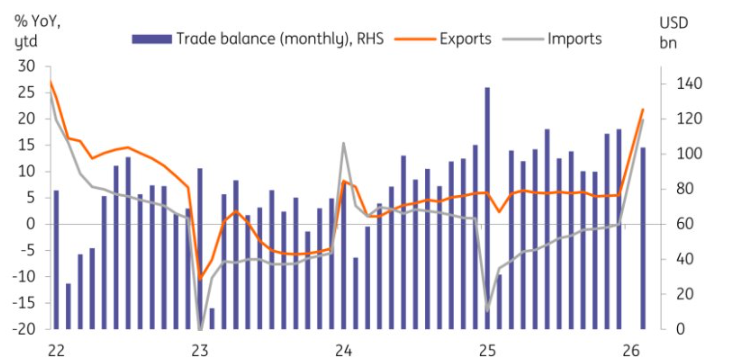
Source: CEIC, ING
The Dollar Holds, But De-Dollarization Trade Keeps Building
The US dollar still holds roughly 58 to 60 percent of global foreign exchange reserves, and no other currency looks ready to replace it at scale right now. The yuan still carries capital controls and lower institutional trust globally. BRICS de-dollarization trade is a gradual dilution, not a sudden replacement. But the ruble, the rupee, and the yuan keep turning up in more of the transactions that make up global commerce, and the swap lines, settlement accounts, and alternative payment systems building up around them are not going away. The infrastructure for a less dollar-dependent trading world takes shape one bilateral deal at a time.