





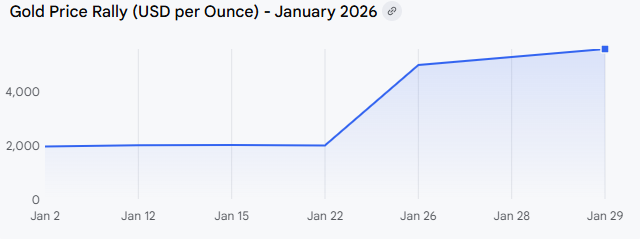
The gold price surged above $5,500 per ounce on January 29, 2026, and hit an intraday record of $5,595.41 as gold futures rallied more than 20% year-to-date right now. The gold price today reflects a historic monetary shift that’s being driven by dollar weakness and also BRICS gold reserves surpassing U.S. Treasury holdings for the first time since 1996. At the time of writing, combined gold holdings at foreign central banks are valued at approximately $4 trillion versus just $3.9 trillion in government bonds.
Also Read: Dollar Collapse Fears: BRICS Built Stronger System That Bypassed It
Gold Futures and BRICS Gold Reserves Drive Price Today

Gold futures jumped on Wednesday as the Federal Reserve held rates steady and the greenback slid to its lowest level since early 2022. President Trump dismissed currency concerns when he was asked about the declining dollar during a stop in Iowa on Tuesday.
“No, I think it’s great.”
The gold price has been climbing as Robin Brooks, senior fellow at the Brookings Institution, said:
“Dollar weakness is supercharging the rise in gold … adding fuel to the fire for the crazy rise in precious metals.”
Gold prices have rallied as the dollar has fallen against other currencies. Expectations of easier Fed policy are also contributing to what’s called the debasement trade. The gold price movement has prompted Ole Hansen, head of commodity strategy at Saxo Bank, to state:
“Unchecked fiscal debt creation continues to erode confidence in fiat currencies.”
BRICS Gold-Backed Currency Reshapes Markets
BRICS nations control approximately 50% of global gold production right now, with combined BRICS gold reserves exceeding 6,000 tonnes. Russia leads with 2,336 tonnes, and China holds 2,298 tonnes, and India maintains 880 tonnes at this point.
Central banks have been accumulating more than 1,000 tonnes of precious metals annually over the past three years. Anuj Gupta, director at Ya Wealth, had this to say:
“BRICS member countries are both producing more gold and selling less. At the same time, they are also purchasing gold from the international market. According to existing data, between 2020 and 2024, the Central Banks of the respective BRICS nations purchased more than 50% of the global gold.”
In December 2025, BRICS launched the Unit, which is a BRICS gold-backed currency pilot program comprising 40% physical gold and 60% BRICS currencies. The initiative marks the first practical step toward an alternative settlement system. This could reshape the gold price outlook going forward. This BRICS gold-backed currency represents a direct challenge to dollar dominance right now.
Sachin Jasuja, head of equities at Centricity WealthTech, stated:
“The decisive shift in thinking followed the Russia-Ukraine war, when Western governments froze a substantial portion of Russia’s foreign exchange reserves. This episode fundamentally altered how sovereign nations perceive reserve safety.”
US dollar holdings in BRICS reserves have been reduced from 58.2% in 2024 to 56.92% in early 2026. This trend was accelerated by the freezing of Russian assets in Western banks back in 2022.
Market Outlook and Price Forecasts
Deutsche Bank has issued a target of $6,000 per ounce for 2026. Goldman Sachs also raised its gold price target to $5,800. The gold price today is being supported by geopolitical tensions as well, with President Trump saying Wednesday that a “massive Armada is headed to Iran.“
Also Read: Gold’s Rise Is Bad News For Shiba Inu: Here’s Why
Silver jumped to $116 per ounce, which represents a surge of roughly 50% year-to-date. Platinum also gained 29% and copper prices topped $13,000 for the first time in London last week. The US dollar Index has been falling, and it dropped roughly 8% in 2025 as alternative settlement mechanisms gained traction across emerging markets.
Gold futures are expected to remain elevated as central banks continue diversifying away from dollar-denominated assets, and the structural shift in BRICS gold reserves suggests the gold price trend is far from over at the time of writing.